
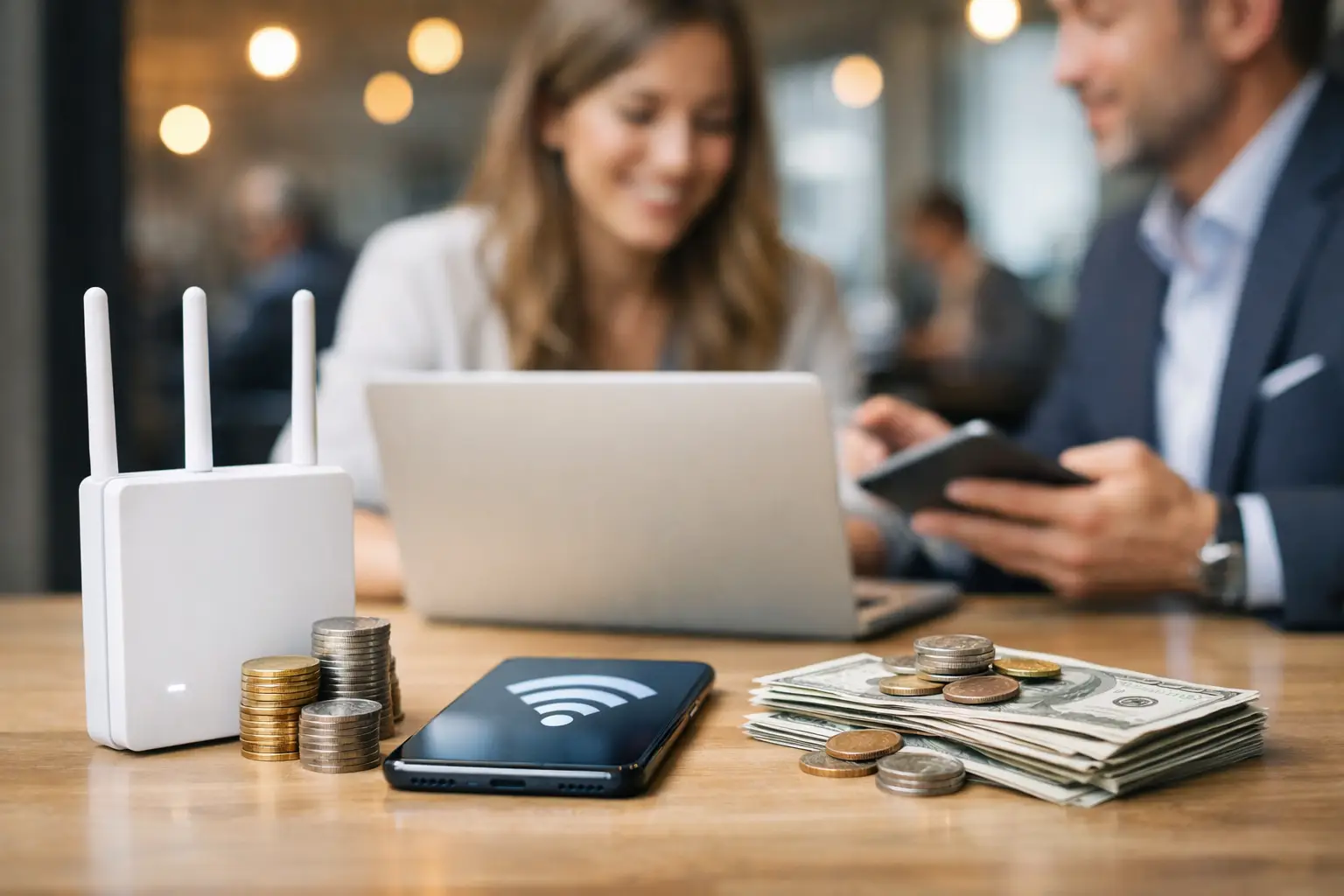
A busy venue can have hundreds or thousands of people connect to guest internet every week, then disappear without a trace. That is the real reason businesses ask how to monetize guest WiFi. The answer is rarely about charging for access alone. The larger opportunity is turning WiFi into a channel for data capture, customer engagement, repeat visits, and measurable revenue.
For hotels, restaurants, retailers, malls, airports, and healthcare locations, guest WiFi already sits close to the point of sale. It reaches people when they are physically on-site, actively engaged, and often one step away from a purchase. If that network only provides internet access, it is doing a fraction of the job it could be doing.
What monetizing guest WiFi actually means
Many operators hear the phrase and think of one model: paid internet tiers. That approach still has a place in some environments, especially transportation hubs, premium hospitality, and large public venues. But for most customer-facing businesses, the strongest return comes from using WiFi as a marketing and communication asset rather than a simple access utility.
Monetization usually falls into three categories. The first is direct revenue, where users pay for premium access, extended sessions, or tiered bandwidth. The second is indirect revenue, where WiFi helps generate more purchases, more repeat visits, and higher customer lifetime value. The third is data-driven revenue efficiency, where first-party data lowers acquisition costs and improves campaign targeting across email, SMS, WhatsApp, and paid media.
For most businesses, the second and third categories outperform the first. Charging every guest for basic access can create friction. Capturing consented customer data and using it well often creates more value over time.
How to monetize guest WiFi without adding friction
The best systems do not treat WiFi login as an IT checkpoint. They treat it as the start of a customer journey. That means the captive portal, sign-in options, consent flows, and follow-up campaigns all need to support revenue goals.
A restaurant might offer free access in exchange for email, mobile number, or social login, then use visit-based segmentation to send bounce-back offers. A hotel might use WiFi login to trigger upsell messages for late checkout, spa packages, or dining promotions. A retail brand might capture customer data in-store, then retarget visitors who browsed but did not buy.
This works because the value exchange feels fair. The guest receives free connectivity. The business receives permission-based access to continue the conversation after the visit.
That is a much stronger model than relying on one-time foot traffic alone.
Start with the captive portal
The portal is where monetization begins. If it is clunky, generic, or asks for too much too soon, conversion drops. If it is branded, fast, and aligned with the venue experience, more guests complete the login.
A strong captive portal should collect the minimum useful information, explain the benefit clearly, and route guests into the right communication path. That path may include an email welcome series, SMS offers, WhatsApp concierge support, review requests, loyalty enrollment, or audience syncing for paid remarketing.
This is where many businesses leave money on the table. They collect data but do nothing with it. Monetization does not come from the form alone. It comes from what happens next.
Use segmentation, not batch messaging
If every guest gets the same follow-up, performance will flatten quickly. A family checking into a resort, a commuter using airport WiFi, and a shopper visiting a luxury store should not receive the same messaging.
Guest WiFi becomes commercially useful when it feeds segmented automation. You can build audiences based on venue, dwell time, visit frequency, device return behavior, time of day, or campaign response. That lets operators send offers that match actual behavior.
A repeat café visitor might get a loyalty incentive. A first-time retail visitor might receive a welcome offer. A hotel guest staying three nights might be a better target for concierge messaging through WhatsApp than a generic email blast. The more relevant the message, the higher the conversion rate.
The strongest revenue models for guest WiFi
Different venues need different monetization models. There is no single formula, but there are patterns that work consistently.
1. Data capture that supports repeat business
For most brick-and-mortar businesses, this is the core model. The WiFi network collects first-party customer data with consent, then feeds automated campaigns that drive return visits and direct bookings or purchases.
This matters more now because paid acquisition is expensive and less predictable. If your venue gets foot traffic every day but does not turn that traffic into an owned audience, you keep paying to reacquire the same customers.
2. On-site upsells during the visit
Guest WiFi can influence spending while the customer is still on premises. A hotel can promote room service, upgrades, or experiences. A stadium can advertise food delivery to seats. A hospital or clinic can use it for service communication and wayfinding. A mall can highlight store promotions based on time and location.
This is one of the fastest ways to show ROI because the sales impact happens immediately.
3. Sponsored access and brand partnerships
In large venues, free WiFi can be funded by sponsorship. Users may watch a short branded message, see a sponsor splash screen, or opt into an offer before receiving access. This model is common in airports, events, transit environments, and high-volume public spaces.
The trade-off is user experience. Too much advertising hurts login completion and brand perception. Sponsored access works best when the venue has significant scale and the advertising feels controlled rather than intrusive.
4. Premium and tiered access
This is the traditional model and still relevant in some settings. A business can offer basic access for free and charge for faster speeds, longer sessions, or enterprise-level connectivity. Hotels, conference centers, and transportation providers can make this work, especially when customer expectations already include paid premium services.
Still, this model has limits. In many everyday venues, charging for WiFi can reduce usage and eliminate the data and marketing opportunities that come with a larger opt-in audience.
How to measure whether your strategy is working
If guest WiFi is treated as a marketing asset, it should be measured like one. The key metrics go beyond login volume.
Look at portal conversion rate, data capture rate, consent rate, returning visitor rate, campaign engagement, redemption rate, and revenue influenced by follow-up messaging. If you sync audiences into ad platforms, track cost efficiency and lift compared with cold targeting. If you use on-site messaging, track attachment sales and incremental spend.
This is where integration matters. The WiFi network should not sit apart from the rest of your marketing stack. It should feed dashboards, automation flows, and customer segments that your team can act on without manual exports.
Common mistakes when trying to monetize guest WiFi
The first mistake is focusing only on access revenue. In many industries, that is the smallest opportunity.
The second is collecting data without a clear activation plan. If contacts go into a spreadsheet and stay there, the network is not monetized. It is just underused.
The third is poor deployment. Unreliable hardware, inconsistent coverage, weak login flow design, and missing compliance controls can all reduce adoption. Businesses need a setup that supports cloud management, remote configuration, and compatibility across different hardware environments.
The fourth is treating every location the same. A quick-service restaurant, a resort, and a healthcare facility have different customer behavior, different dwell times, and different communication needs. The WiFi strategy should reflect that reality.
Why the best approach is operational, not just technical
Businesses do not need more disconnected tools. They need a system that ties on-site traffic to digital follow-up in a way that sales and marketing teams can actually use. That is why the strongest guest WiFi programs combine network access, branded portals, automation, analytics, and implementation support.
Done well, guest WiFi becomes more than infrastructure. It becomes a measurable acquisition and retention channel. One platform, Wifi Marketing, is built around that model, helping venues turn in-person visits into audience growth, automated outreach, and better campaign performance without forcing internal teams to build everything from scratch.
The practical question is not whether your business offers free internet. It is whether that network is helping you grow. If people are already connecting in your locations, the opportunity is already there. The next move is to make every login lead somewhere useful.
Comments are closed