
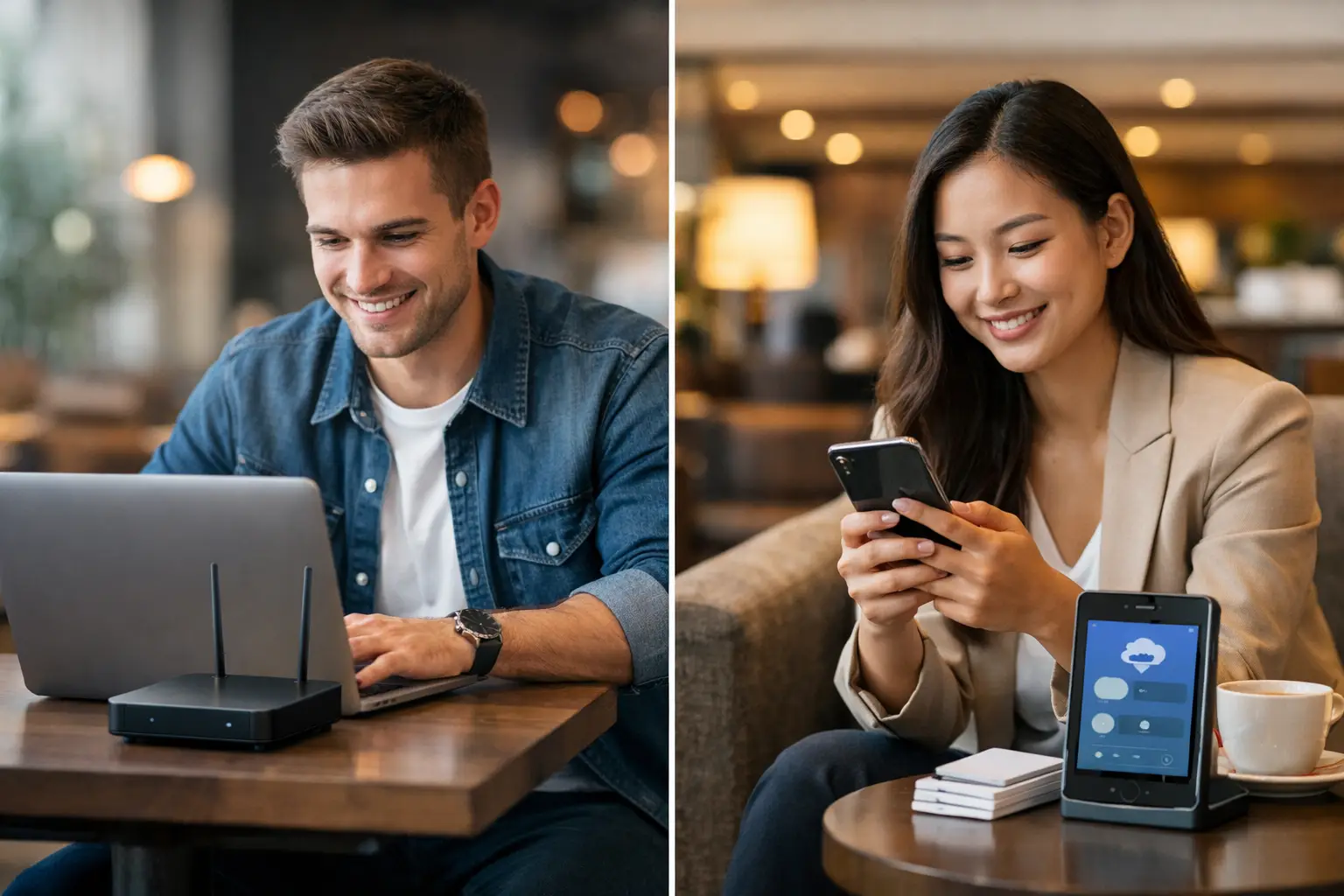
A hotel guest checks in after a delayed flight. A restaurant customer sits down for lunch. A shopper waits while a purchase is processed. In each moment, guest WiFi vs mobile app is not simply a technology decision. It determines how easily your business can turn a physical visit into a permission-based customer relationship.
Both channels can support loyalty, personalization, and repeat revenue. But they solve different problems. A mobile app can create a high-value experience for an already engaged customer. Guest WiFi can create an immediate connection with the much larger group of visitors who may never download an app. For most customer-facing businesses, the strongest strategy is not choosing one in isolation. It is deciding which channel should lead at each stage of the customer journey.
Guest WiFi vs Mobile App: The Core Difference
Guest WiFi is a low-friction entry point. A visitor needs connectivity, joins the network, and encounters a branded captive portal before receiving access. That moment can be used to capture consent, gather customer data, present an offer, invite loyalty enrollment, or start an automated follow-up sequence.
A mobile app requires a bigger commitment. Customers must find it, download it, create an account, approve permissions, and decide it is worth keeping. When the app delivers meaningful ongoing value, that commitment can pay off. It can support loyalty balances, mobile ordering, reservations, digital keys, payment, personalized content, and push notifications.
The distinction matters because adoption is rarely equal. A busy airport, hospital, retail center, or independent restaurant may see thousands of visitors each month, while only a small percentage are likely to install a branded app. WiFi provides a practical way to communicate with a wider share of on-site traffic without asking every first-time visitor to take several additional steps.
Where Guest WiFi Has the Advantage
It reaches customers at the point of visit
Guest WiFi is activated by a real-world need. Visitors often want to browse, work, message, stream, or avoid using mobile data. That creates an organic interaction at precisely the moment they are inside your venue.
For a hotel, the WiFi login can introduce a late checkout offer, spa promotion, restaurant hours, or WhatsApp concierge option. For a restaurant, it can support a return-visit offer after the meal. For retail, it can capture a customer profile that helps connect in-store visits with later email, SMS, or paid remarketing campaigns.
An app cannot reliably reach a person who has not downloaded it. Guest WiFi can begin the relationship before that decision is made.
It supports first-party data collection at scale
Paid acquisition costs continue to rise, and anonymous foot traffic has limited long-term value. A managed guest WiFi network can convert eligible visitors into opted-in, identifiable audiences. Depending on the configuration and consent requirements, businesses can capture information such as email address, phone number, language preference, visit date, location, and customer segment.
This is more useful than a generic email list. A multi-location restaurant group can distinguish guests by store. A hotel operator can separate leisure travelers from corporate event attendees. A mall can identify repeat visitors and build campaigns around the stores, events, or services most relevant to them.
The operational value comes from what happens next. Data can feed email automation, SMS or WhatsApp outreach, customer relationship systems, and remarketing audiences through platforms such as Google and Facebook. The WiFi network becomes a measurable acquisition channel rather than a cost of doing business.
It has a lower barrier to entry
Mobile app development and maintenance are ongoing commitments. Businesses need to consider design, operating-system updates, security, app store requirements, user support, analytics, and a compelling reason for customers to return to the app. The investment can be justified, especially for brands with high purchase frequency or transaction-heavy workflows, but it should be justified by a real use case.
Guest WiFi typically has a faster path to deployment. Existing access points may be compatible, hardware can often be configured remotely, and a branded captive portal can be adapted by venue, campaign, or season. This makes WiFi marketing particularly attractive for independent operators, multi-location brands, agencies, and technology integrators that need a repeatable service offering without building custom software.
Where a Mobile App Has the Advantage
A mobile app becomes more valuable after a customer has chosen an ongoing relationship with the brand. It can deliver capabilities that WiFi alone cannot fully replace.
For example, a hotel app may provide mobile check-in, room access, service requests, and itinerary details. A quick-service restaurant app may support ordering, payment, rewards, and saved preferences. A retailer may use an app for barcode scanning, exclusive member pricing, and purchase history.
Apps also enable direct push notifications, although those permissions must be earned. The best app notifications are timely and useful: a loyalty reward about to expire, an order ready for pickup, an appointment reminder, or a location-specific offer. Promotional messages without clear value quickly lead to notification opt-outs or app deletion.
The trade-off is reach. An app audience is often more engaged, but much smaller than the total number of people who visit a location. That makes app marketing powerful for retention, not always ideal for initial customer acquisition.
The Better Model: Use WiFi to Earn App Adoption
For many businesses, guest WiFi and a mobile app should work as a connected funnel rather than competing channels. WiFi captures interest during the physical visit. Automated communication builds trust after the visit. The app is then presented to customers who have a strong reason to install it.
A hotel can offer WiFi access through a branded portal, then send a post-stay message inviting guests to use an app for faster future check-in, rewards, and concierge access. A restaurant can use WiFi to collect opted-in guest data, identify repeat visitors, and promote app-only ordering or loyalty benefits to its most frequent customers.
This sequence is more effective than placing a generic «download our app» sign at the register. The invitation arrives after the business has already provided value and has context about the visitor’s location, behavior, and likely interests.
Wifi Marketing supports this approach by connecting captive portals, data capture, audience segmentation, automated outreach, and remarketing into one operational system. Instead of treating WiFi as separate IT infrastructure, operators can use it as the first step in a broader customer communication program.
How to Choose the Right Primary Channel
The decision should reflect your business model, visit frequency, and customer experience goals.
Guest WiFi should be the primary acquisition channel when your venue receives high volumes of first-time or occasional visitors, when connectivity is naturally valuable, or when you need to build a permission-based marketing database. It is especially effective in hotels, restaurants, waiting areas, retail stores, malls, transportation venues, healthcare facilities, and public spaces.
A mobile app should be the primary retention channel when customers have a recurring reason to use it beyond promotions. That may include ordering, payments, loyalty management, booking, digital access, or personalized service. If the app offers no meaningful utility between visits, adoption will usually remain limited.
Businesses with multiple locations should also consider reporting requirements. A centralized WiFi marketing platform can compare customer acquisition, repeat visits, portal conversions, campaign results, and opt-in performance across locations. That visibility helps operators identify which venues are generating valuable audiences and which offers are driving measurable action.
Avoid the Common Mistakes
The first mistake is treating guest WiFi as a utility with no marketing strategy. Offering free connectivity is good customer service, but it leaves value on the table if there is no branded experience, consent flow, segmentation, or follow-up plan.
The second is treating an app as a loyalty strategy by itself. A download count is not loyalty. Active usage, repeat purchases, and customer lifetime value are the metrics that matter. If customers only open the app to claim a discount, the business has created an expensive coupon channel rather than a durable relationship.
The third is over-communicating. Whether you collect data through WiFi or an app, relevance protects your brand. A guest who visited once six months ago should not receive the same message cadence as a loyal weekly customer. Segment audiences by location, visit behavior, consent status, and demonstrated interest, then make each message useful.
Build the Channel Mix Around Customer Value
The practical question is not whether guest WiFi or a mobile app is better in every situation. It is where each one removes friction and adds value. WiFi can make the first connection easy, measurable, and scalable. An app can deepen that relationship when it simplifies a task customers already want to complete.
Start with the infrastructure customers use today. Turn venue traffic into permission-based audiences, automate relevant follow-up, and invite high-intent customers into richer loyalty experiences when the value is clear. That is how a free WiFi network becomes more than an amenity: it becomes a customer growth asset.
Comments are closed