
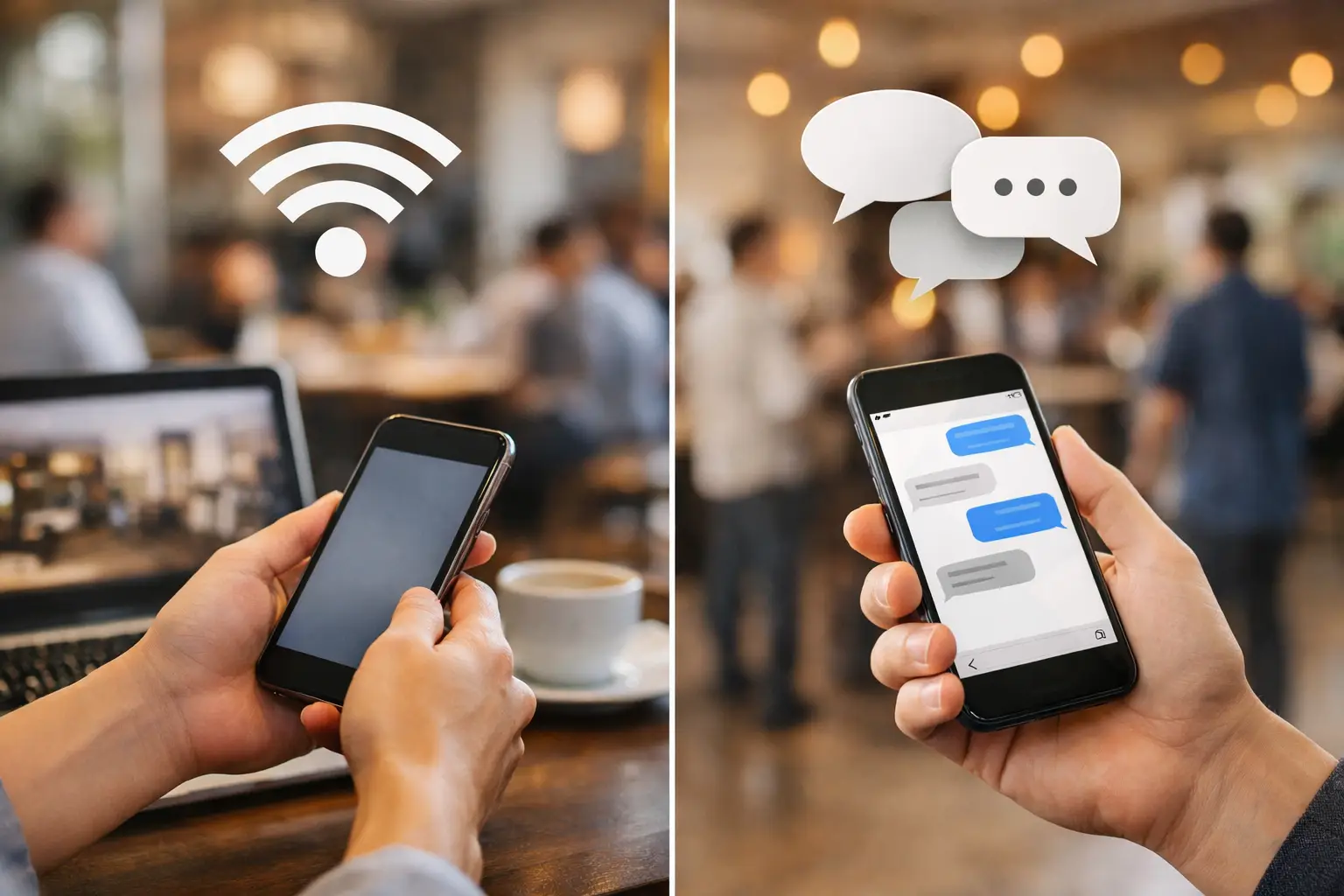
A guest walks into your restaurant, hotel, store, or venue and connects to free Wi-Fi. That moment creates an opportunity that a typical ad campaign cannot: the ability to recognize an on-site visit, collect permission-based customer data, and begin a relevant conversation. In the decision between wifi marketing vs sms marketing, the strongest strategy is rarely choosing one channel and ignoring the other. It is knowing what each channel does best, then connecting them through a compliant, measurable customer journey.
For physical businesses, WiFi marketing is often the starting point because it turns an existing guest amenity into a first-party data and engagement channel. SMS marketing can then provide the speed and visibility needed to bring opted-in customers back. The difference matters because each channel reaches customers at a different stage of the relationship.
WiFi Marketing vs SMS Marketing: The Core Difference
WiFi marketing begins when a customer uses guest Wi-Fi. Instead of connecting through a generic password alone, the visitor sees a branded captive portal. They may log in using an email address, mobile number, social profile, loyalty account, or a simple form that collects the information your business needs.
This process gives businesses context that SMS alone cannot provide. You can identify when someone visited, which location they visited, how often they return, how long they remain connected, and whether they are a first-time or repeat guest. A multi-location restaurant group, for example, can distinguish between customers who visit a downtown location every week and travelers who connected once at an airport location.
SMS marketing is a direct outbound messaging channel. With proper opt-in consent, it allows a business to send time-sensitive messages to a customer’s phone. A limited-time offer, appointment reminder, service update, table-ready notification, or loyalty incentive can be read within minutes.
The practical distinction is simple: WiFi marketing helps capture and understand the in-person audience; SMS marketing helps activate customers after they have granted permission to receive texts. One creates a valuable data foundation. The other can turn that data into immediate action.
What WiFi Marketing Does Better
Guest Wi-Fi is especially effective at connecting physical traffic with digital marketing. Many venue operators know how many transactions occurred, but not enough about the people behind them. WiFi marketing closes part of that gap by connecting visits to customer profiles and marketing permission.
It captures first-party data at the point of visit
A customer who joins your network is already engaged with your location. This makes the Wi-Fi login screen a natural place to present your brand, explain the value exchange, and request consent for future communications. Unlike data purchased from third parties, the information comes from an interaction at your business.
For hotels, that can mean segmenting guests by property, stay behavior, or repeat visits. For retail, it can mean identifying shoppers who visit frequently but have not joined a loyalty program. For hospitals and public waiting areas, the emphasis may be on useful connectivity and carefully designed service communication rather than promotional outreach.
It creates location-based behavioral insight
SMS platforms can report delivery, clicks, and responses. They do not inherently tell you that a person physically arrived at one of your locations. WiFi marketing adds on-site behavior to the customer record.
This insight supports better segmentation. A café can create a follow-up audience of guests who have visited twice in 30 days. A mall can identify visitors across different zones or participating tenants, subject to its privacy policy and network design. A transportation provider can use guest Wi-Fi interactions to improve traveler communications around a specific terminal, route, or service area.
It supports more than text messaging
A Wi-Fi marketing platform can route customers into email automation, SMS or WhatsApp outreach, loyalty campaigns, surveys, and remarketing audiences. It can also integrate tracking tools such as Facebook and Google Pixel to help businesses measure and improve paid campaigns.
That flexibility matters when communication preferences vary. Some customers will respond to a text offer. Others prefer email receipts, event updates, or a helpful WhatsApp message. An intelligent customized concierge can also use WhatsApp to answer common guest questions, provide service information, and move conversations forward without placing the full workload on staff.
Where SMS Marketing Has the Advantage
SMS is powerful because it is immediate. Once a customer has clearly opted in, a well-timed text can generate action faster than most email campaigns and without requiring the customer to be connected to your Wi-Fi network.
A restaurant can fill a slow Tuesday dinner period with an offer sent to nearby regulars. A hotel can send a check-in instruction or late-arrival update. A retail store can notify loyalty members that a product they requested is back in stock. In each case, the message has a clear purpose and a short path to conversion.
It is ideal for urgent and time-bound messages
If timing is the main factor, SMS is usually the better channel. Weather closures, appointment confirmations, order updates, flash promotions, and event reminders all benefit from text messaging’s high visibility.
However, high visibility also creates a higher standard for relevance. Customers are protective of their text inboxes. Sending frequent, generic promotions may drive unsubscribes and weaken brand trust. SMS works best when the message is expected, useful, personalized, and sent at a reasonable time.
It drives fast campaign measurement
Text campaigns can be measured through delivery rates, click activity, coupon redemptions, replies, conversions, and opt-outs. When paired with location and customer data captured through Wi-Fi, those metrics become more meaningful.
For example, instead of sending a discount to every subscriber, a retailer can send it to customers who visited a specific store but have not returned in 45 days. That reduces wasted sends and gives the promotion a clearer business purpose.
The Compliance Difference Is Not Optional
WiFi marketing and SMS marketing both require careful consent practices, but SMS carries particularly strict requirements. A mobile number collected during Wi-Fi login is not automatically permission to send promotional text messages. The captive portal must present clear SMS consent language, and records of consent should be retained.
Businesses should also provide straightforward opt-out instructions, honor opt-outs promptly, and separate marketing consent from terms that are required to access basic guest Wi-Fi when appropriate. Consent language, privacy notices, messaging frequency disclosures, and campaign practices should be reviewed with qualified legal counsel based on your business model and applicable regulations.
This is not merely a compliance task. Clear permission improves campaign quality. A smaller list of customers who actively want your messages will usually outperform a large list built on vague or assumed consent.
How to Use Both Channels in One Customer Journey
The best WiFi marketing vs SMS marketing decision is often a channel design decision. Use Wi-Fi to make the first on-site interaction more valuable, then use SMS selectively when a customer has opted in and a text message is genuinely useful.
Consider a casual dining group. A guest joins Wi-Fi through a branded login page and selects an option to receive special offers by text. The system records the location and visit date. After the guest’s second visit, the business can trigger a welcome message with a loyalty incentive. If the guest does not return after several weeks, a targeted SMS may offer a reason to come back. If the customer visits again, automated follow-up can shift to an email survey or a personalized promotion based on their behavior.
This approach is more effective than treating every customer identically. It also gives operators a clearer view of how campaigns influence real visits, not just clicks.
Build segments around commercial decisions
Useful segments should reflect the decisions your team needs to make. Start with first-time versus repeat visitors, high-frequency versus lapsed guests, location-specific audiences, and customers who opted into distinct communication channels. From there, campaigns can become more precise without becoming overly complicated.
A platform such as Wifi Marketing helps operators configure the captive portal, connect hardware across multiple brands, manage data centrally, and train teams to use dashboards and automation. That implementation layer is important: customer data only creates value when it reaches the people and workflows responsible for acting on it.
Match the message to the moment
Use Wi-Fi for welcome experiences, data capture, on-site promotions, feedback requests, and building a remarketing audience. Use SMS for confirmations, reminders, limited-time offers, service alerts, and carefully targeted return-visit campaigns.
Do not force every communication into a text message. A detailed event schedule may work better by email. A guest support request may belong in WhatsApp. A simple, urgent update is often right for SMS. Channel choice should follow customer intent, not just the newest feature available in your marketing stack.
Choosing the Right Priority for Your Business
If your business has substantial walk-in traffic and underused guest Wi-Fi, start with WiFi marketing. It provides a practical way to identify visitors, collect first-party data, and create the segments that make later campaigns more profitable. This is especially valuable for hotels, restaurants, retail stores, malls, airports, and other venues where the physical visit is central to the customer relationship.
If you already have a compliant, engaged SMS list but lack a way to connect messages to in-person behavior, focus on integrating your text strategy with Wi-Fi data. You may discover that certain locations, visit patterns, or customer groups respond very differently to the same offer.
The goal is not to send more messages. It is to make each customer interaction more relevant, measurable, and useful. Start with the moment guests enter your location, earn their permission through a clear value exchange, and let their behavior guide the next conversation.
Comments are closed