A guest who walks into your restaurant, hotel, retail store, or waiting area already has a phone in hand. The business question is not whether that customer can connect to Wi-Fi. It is whether that moment becomes a measurable relationship. In the decision between wifi portals vs loyalty apps, the right choice depends on how much friction your customers will tolerate and how much customer data your team needs to act on.
For most physical businesses, guest Wi-Fi portals offer the faster path to data capture and follow-up. Loyalty apps can create deeper engagement for high-frequency customers, but they require a stronger brand relationship, a clearer member benefit, and continued investment to keep people downloading and using them. The most effective strategy is often not a strict either-or decision. It is using the Wi-Fi connection as the first step and directing the most valuable guests toward a loyalty program when the timing is right.
What a Wi-Fi Portal Actually Does
A Wi-Fi portal, often called a captive portal, is the branded page a guest sees before receiving access to a venue’s free Wi-Fi. Instead of simply providing a password on a sign, the business can ask guests to log in using email, mobile number, social sign-in, or a short form.
That interaction turns anonymous foot traffic into permission-based first-party data. A hotel can capture guest contact details at check-in or throughout shared areas. A restaurant can identify diners who visit at lunch but have not returned for dinner. A retail location can recognize returning visitors and build audience segments by store, visit frequency, and time of day.
The operational value extends beyond the initial form. A properly configured portal can trigger a welcome message, add the visitor to an approved email or SMS workflow, and pass consented audience data into remarketing platforms. It gives marketing teams a bridge between the person who visited a physical location and the campaigns that run afterward.
What Loyalty Apps Do Well
A loyalty app is designed for an ongoing member relationship. It usually supports point balances, rewards, mobile ordering, offers, digital receipts, location-specific promotions, and account history. For a coffee chain with frequent transactions or a retailer with an established rewards culture, an app can become a valuable customer channel.
Apps work best when customers have a reason to return regularly and receive a benefit substantial enough to justify installation. If a guest earns points on every purchase, skips a line, gets personalized offers, or manages reservations, the app provides practical value beyond another promotional notification.
The trade-off is adoption. Downloading an app requires more effort than joining Wi-Fi. The customer must find it, install it, create an account, and allow enough permissions for the experience to be useful. Many venue operators invest heavily in app development only to find that adoption is limited to their most loyal customers.
That does not make loyalty apps a poor investment. It means they should be evaluated as a retention system, not as the primary way to identify every new visitor walking through the door.
WiFi Portals vs Loyalty Apps: The Core Difference
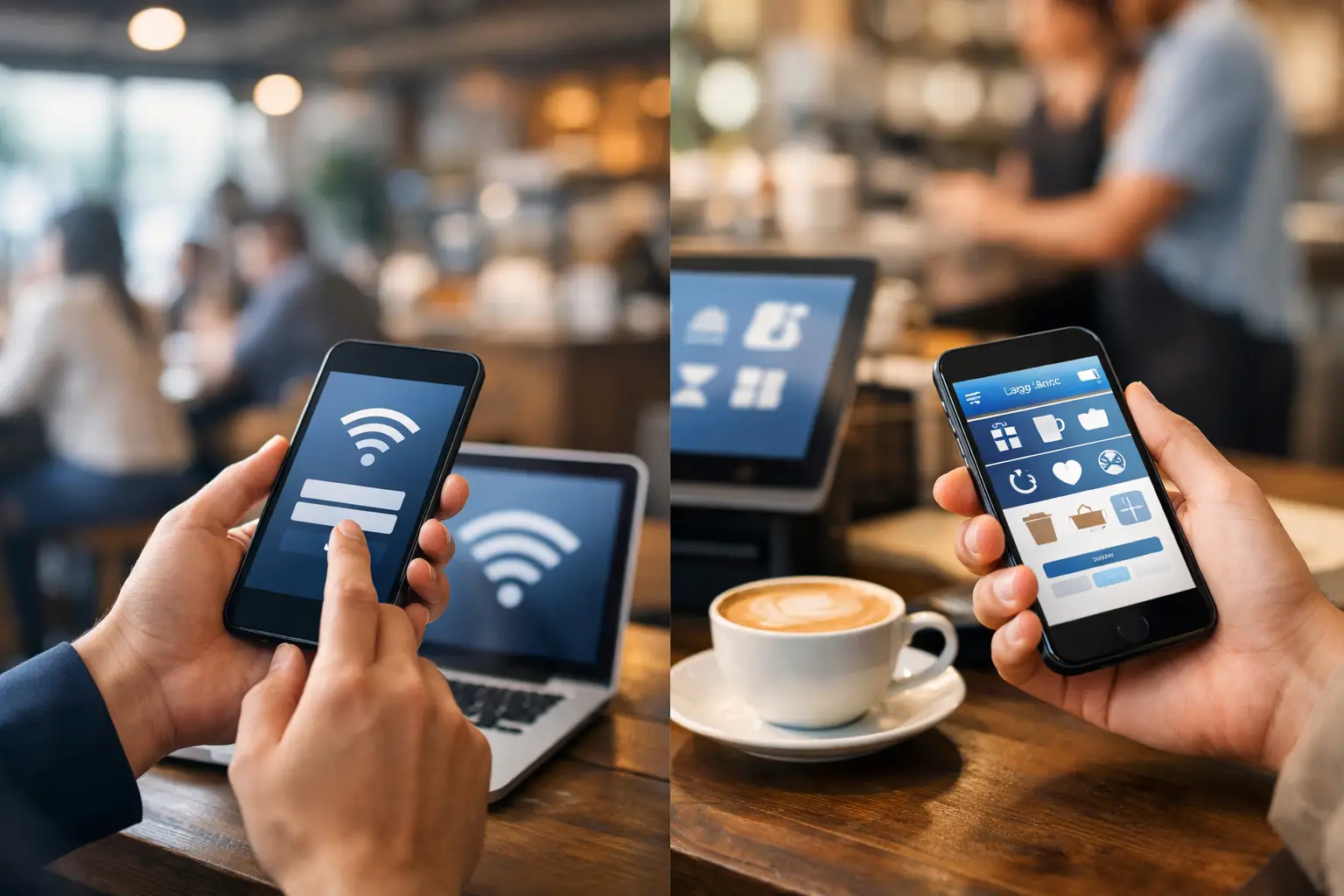
The practical difference between WiFi portals vs loyalty apps is the point of entry. A Wi-Fi portal captures the broadest possible audience because the customer wants internet access now. A loyalty app serves customers who are willing to make a larger commitment because they expect continued value.
A portal is usually stronger at acquisition and immediate data capture. It can be deployed across locations, branded by venue or campaign, and configured remotely without asking a customer to change behavior beyond logging in. It is especially useful for businesses with occasional visitors, high foot traffic, or long dwell times.
An app is usually stronger at deepening loyalty after the relationship exists. It can support richer account-level experiences and repeat-purchase mechanics that a portal alone may not provide. But it takes ongoing product management, promotion, and rewards funding to remain relevant on a customer’s phone.
For operators facing rising paid media costs, the portal offers a lower-friction way to build an owned audience from people already on-site. Rather than paying repeatedly to reach someone who has previously visited, the business can use approved email, SMS, WhatsApp, and remarketing campaigns to encourage the next visit.
Compare Them by the Metrics That Matter
Technology comparisons can become unproductive when they focus only on features. Venue operators should compare these channels against commercial outcomes: audience growth, consent quality, repeat visits, campaign conversion, and cost to re-engage a known customer.
Customer adoption and reach
Guest Wi-Fi portals have a natural advantage when the venue provides free internet and makes the login experience quick. Airports, hotels, malls, medical waiting areas, public venues, and transportation providers are particularly strong use cases because visitors often need connectivity immediately.
Loyalty apps have more selective reach. Their audience may be smaller, but it can be highly valuable if members purchase often. A quick-service restaurant with a strong rewards offer may find that app users spend more and return more frequently than nonmembers. The limitation is that many first-time or infrequent visitors will never download it.
First-party data and segmentation
Both channels can collect customer information, but portals typically capture it earlier in the customer journey. With the right consent language and privacy controls, businesses can collect contact information and build segments around location, time, device, visit behavior, and campaign source.
This helps marketers move beyond one generic promotional list. A hotel group might segment guests by property. A multi-location retailer might create audiences for customers who visited a specific store but have not come back in 60 days. A restaurant can send a weekday lunch offer to customers whose Wi-Fi visits suggest a regular workday pattern.
Apps can provide richer behavioral data when tied to transactions, rewards, and user profiles. However, that value only applies to the customers who have installed and actively use the app. A Wi-Fi platform expands the top of the funnel, while app data can enrich the relationship further down it.
Cost, deployment, and internal workload
A custom loyalty app can involve development costs, app store maintenance, integrations, security reviews, feature updates, and ongoing promotion. Even a white-label app needs active management to avoid becoming an unused icon on a customer’s phone.
A cloud-managed Wi-Fi marketing platform is generally faster to implement because it builds on infrastructure the venue may already operate. Hardware can be configured for multi-brand environments, portals can be updated remotely, and campaigns can be managed from a central dashboard. This matters for operators with multiple locations and limited internal technical resources.
Wifi Marketing supports this model through portal configuration, customer data capture, automated communications, analytics, and implementation support. The objective is not simply to offer internet access. It is to make the existing guest network accountable to marketing and retention goals.
Where Each Option Fits Best
Hotels benefit from Wi-Fi portals because the guest network is already part of the stay. The portal can support property-specific messaging, collect preference data, promote amenities, and maintain a relationship after checkout. A loyalty app is useful for larger hospitality brands with repeat guests and an established rewards ecosystem, but it should not replace the portal’s ability to identify and communicate with on-property visitors.
Restaurants can use portals to grow an audience from dine-in traffic, particularly when online ordering data does not capture every guest at the table. An app makes more sense for brands with high purchase frequency, mobile ordering, and a meaningful points program. Independent restaurants and small groups may achieve better returns by starting with Wi-Fi data capture and targeted follow-up campaigns.
Retail stores gain value from portals when they need more visibility into store visits that do not become immediate transactions. They can build local audiences, promote new arrivals, and retarget consented visitors after they leave. A loyalty app becomes more compelling when the retailer has a broad catalog, regular promotional cadence, and customers who benefit from account-level offers.
Healthcare facilities, airports, malls, transit locations, and public venues often have less reason to push an app download. Their visitors may be occasional, and the immediate need is access to connectivity. Here, a branded portal is usually the more practical and scalable engagement layer.
Build a Better Customer Journey Instead of Choosing a Side
The strongest approach is to treat the portal and the app as connected stages of one customer journey. Use the Wi-Fi portal to welcome visitors, capture permission-based data, and deliver useful on-site information. Then invite customers with demonstrated interest to join the loyalty program through a relevant incentive, such as a reward, priority service, or member-only offer.
Avoid forcing every Wi-Fi user into an app download before granting access. That adds friction at the exact moment customers want a quick connection and can reduce portal completion rates. It also creates a poor first impression for visitors who may only be at the location once.
Instead, use the data to make a smarter invitation. A customer who has visited three times in a month is a better candidate for a rewards app than someone who connected once while waiting for an appointment. This is where segmentation and automation create practical value: the message matches the visitor’s behavior rather than the business sending the same pitch to everyone.
The best customer channel is the one your guests will actually use and your team can consistently activate. Start by making every physical visit visible, permission-based, and actionable. From there, loyalty becomes less about asking customers to download one more app and more about giving the right customers a reason to come back.