
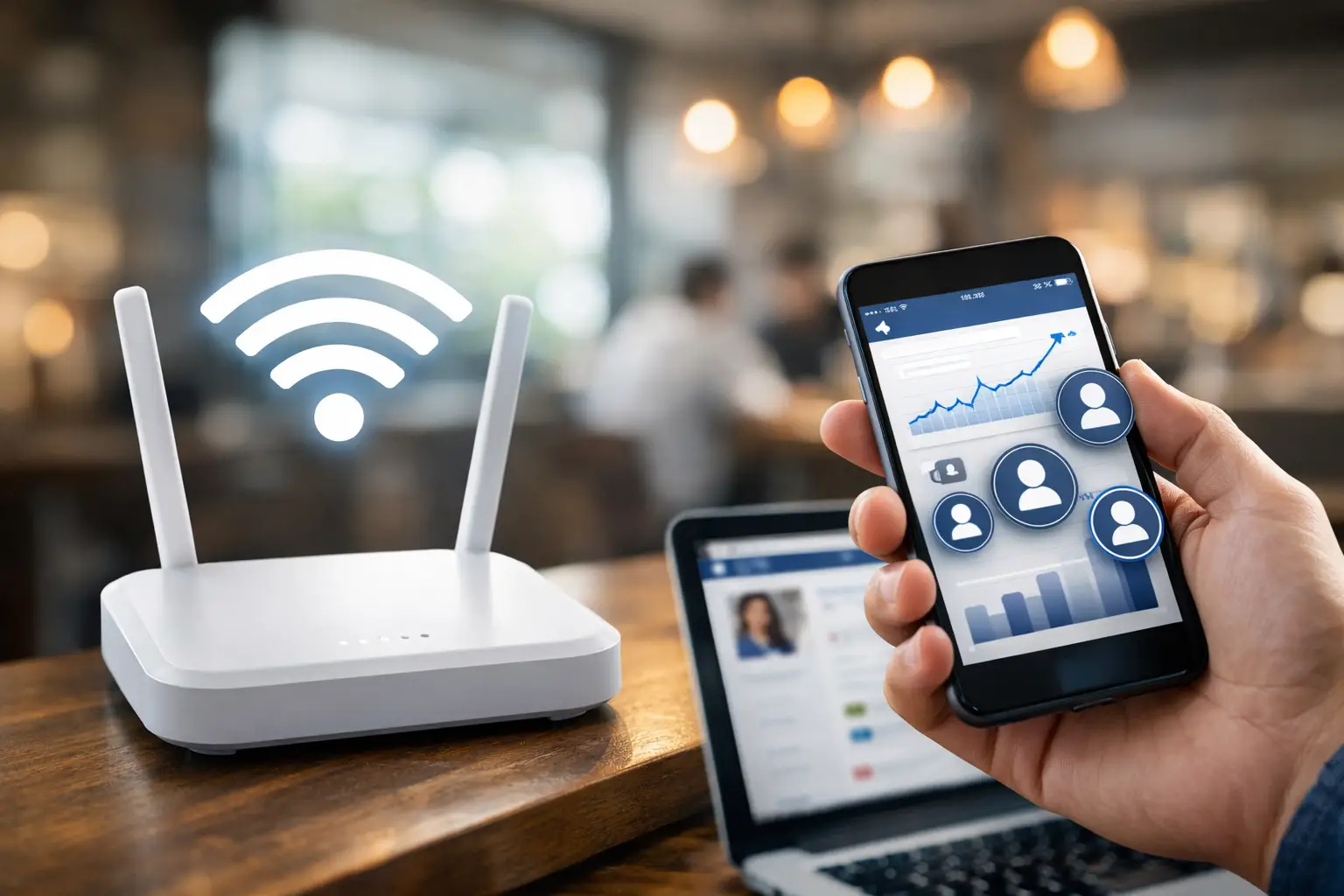
Most venues already pay for guest Wi-Fi. Very few turn it into a repeat-visit engine. That is where wifi remarketing with facebook pixel changes the economics of foot traffic. Instead of treating guest access as a utility, businesses can use it to identify audiences, segment visitors, and re-engage them later with paid social campaigns tied to real on-site behavior.
For operators under pressure to make every marketing dollar work harder, this matters. Ad costs keep rising, third-party data keeps getting weaker, and many physical businesses still have a blind spot between a visit and a follow-up campaign. Guest Wi-Fi helps close that gap by turning anonymous visits into measurable first-party marketing opportunities.
What wifi remarketing with facebook pixel actually does
At a practical level, the process is straightforward. A customer joins your guest Wi-Fi through a branded captive portal. During that interaction, your venue captures permission-based customer data and behavioral signals such as visit time, location, and frequency. The Facebook Pixel, configured within that flow and your landing environment, helps build remarketing audiences based on those visits.
That means a restaurant can promote lunch offers to weekday visitors, a retailer can retarget shoppers who entered a flagship location but did not return, and a hotel can keep past guests engaged after checkout with offers for dining, events, or future stays. Instead of targeting broad local audiences, you are marketing to people who have already shown real-world intent.
The value is not just that ads become more relevant. It is that your media budget is spent on warmer audiences. For most location-based businesses, that improves efficiency faster than simply increasing ad spend.
Why physical businesses benefit more than digital-only brands
Digital brands already have plenty of ways to track website activity. Physical businesses usually do not. A visitor can spend 45 minutes in a venue, browse products, ask questions, and leave with zero usable marketing data if there is no capture point.
Guest Wi-Fi creates that capture point without adding friction to the customer experience when it is implemented correctly. Instead of hoping a visitor later searches for your business online, you create a direct path from in-person presence to digital follow-up.
This is especially useful in industries where repeat visits drive margin. Restaurants, hotels, clinics, transportation hubs, malls, and large venues all face the same issue: they generate traffic every day, but not every visitor becomes part of a usable audience. WiFi remarketing changes that by converting existing infrastructure into a customer acquisition and retention channel.
There is also a cost advantage. Retargeting known visitors generally outperforms cold outreach because the audience already knows the brand. Results will vary by industry and offer, but many businesses see better click-through rates and lower wasted impressions when remarketing is based on on-site activity rather than broad demographic targeting.
How the setup works in the real world
The core setup usually starts with a branded captive portal connected to the venue’s guest network. That portal can ask visitors to log in through an email form, social login, SMS verification, or another approved method, depending on the business model and compliance needs. The portal then passes consented audience signals into connected marketing systems.
The Facebook Pixel is typically installed in the portal environment or relevant connected pages so user sessions can contribute to audience building. From there, the business can create campaigns in Meta based on visitors who accessed Wi-Fi, completed specific steps, or belong to selected segments.
This sounds simple, but execution matters. The quality of the login flow, consent language, network stability, hardware compatibility, and campaign structure all affect outcomes. A poor setup can create drop-off at the portal or incomplete audience matching. A strong setup feels fast for the guest and produces cleaner data for the marketing team.
That is why many operators prefer a managed approach rather than stitching together hardware vendors, ad platforms, and custom scripts on their own. The technology is only part of the job. Configuration, deployment, and dashboard training are what turn it into a repeatable marketing channel.
WiFi remarketing with Facebook Pixel is really about segmentation
The biggest mistake businesses make is treating all visitors the same. A first-time shopper should not get the same message as a weekly regular. A hotel guest who stayed three nights has different value than someone who only used lobby Wi-Fi for ten minutes.
Segmentation is where wifi remarketing with facebook pixel starts producing better business results. Instead of building one generic audience, you can create groups based on visit frequency, dwell time, venue type, campaign source, or even time of day. That lets you align creative and budget with actual customer value.
A retail chain might segment by store location and promote a local event only to recent visitors from that branch. A quick-service restaurant might separate lunch and dinner traffic to test different offers. A hospital or clinic might use more careful, compliance-aware messaging tied to service awareness rather than direct promotional language. The strategy depends on the category, but the principle stays the same: relevance improves performance.
This also supports better coordination across channels. The same Wi-Fi data can inform email automation, SMS outreach, and WhatsApp communication, creating a more complete follow-up sequence rather than relying on ads alone.
What to watch before you invest
Not every business will get the same result, and there are trade-offs. If your venue has low foot traffic, limited repeat visits, or weak customer intent, remarketing audiences may build slowly. If the guest Wi-Fi adoption rate is low because mobile coverage is strong and customers do not need the network, your capture opportunity may be smaller.
Privacy and consent also matter. Businesses need a clear, compliant customer data strategy and a login experience that explains how information is used. That is not just a legal issue. It affects trust, completion rates, and long-term brand value.
There is also the issue of campaign discipline. Building audiences is only useful if your creative, frequency, and offers are well managed. Poor ad strategy can waste a good data source. Strong remarketing still needs testing, exclusions, and sensible attribution.
For multi-location brands, consistency becomes another factor. Different hardware, internet providers, or local operating practices can create uneven performance unless the rollout is standardized. This is where a cloud-managed platform with remote configuration support has a clear advantage.
Where the strongest ROI usually shows up
The best returns tend to come from businesses with recurring traffic, clear offers, and enough scale to build useful segments. Hotels can retarget guests for direct bookings and on-site amenities. Restaurants can drive return visits with time-sensitive promotions. Retailers can reconnect with store visitors after product launches or seasonal campaigns.
Transportation venues, malls, airports, and public spaces are also strong use cases because of their steady footfall and mixed visitor types. In those environments, guest Wi-Fi can function as both a service layer and a data capture layer. That opens the door to campaign strategies based on location, dwell behavior, and repeat presence.
Agencies and technology partners can also benefit. For them, WiFi remarketing adds a measurable service line that connects physical customer behavior with digital ad execution. It gives clients a more complete attribution story and creates another reason to retain agency support over time.
For businesses looking to operationalize this without internal complexity, a partner like Wifi Marketing can combine captive portal setup, hardware compatibility, cloud software, automation, and campaign-ready data flows into one deployment model. That reduces the gap between installation and results.
The bigger strategic advantage
The real opportunity is not just cheaper retargeting. It is owning more of your first-party audience at the venue level. As paid media becomes less predictable and customer acquisition gets more expensive, businesses need assets they control. Guest Wi-Fi is one of the few existing systems in physical locations that can support that shift without requiring a full digital transformation project.
When properly configured, it turns a basic operational service into a marketing system tied to acquisition, retention, and customer intelligence. That makes it useful not only for the marketing team, but also for operations, ownership, and multi-site leadership focused on performance.
If your venue already has traffic, the question is not whether there is marketing value in that traffic. The question is whether your infrastructure is capturing it or letting it walk out the door.
Comments are closed