
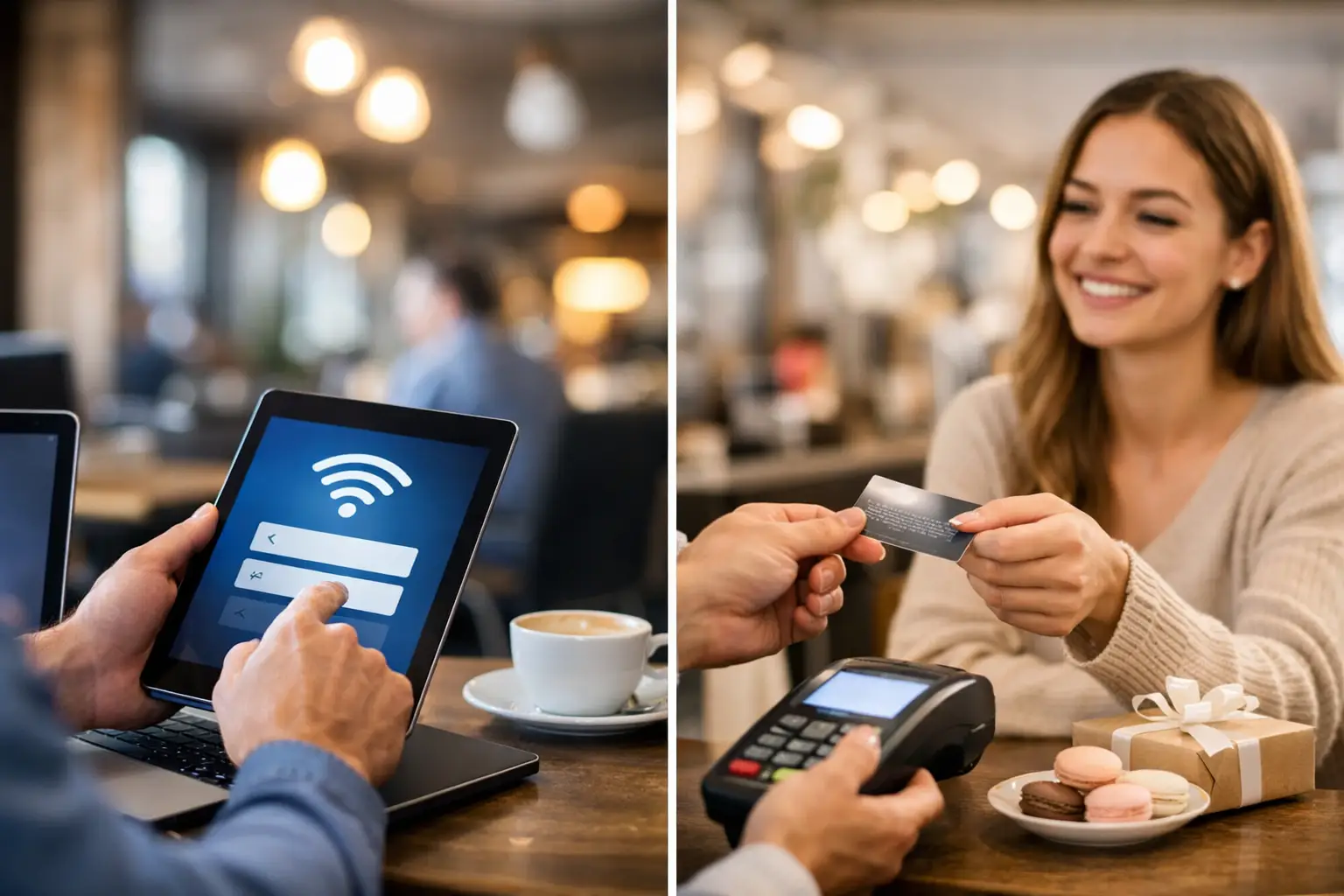
A guest joins your Wi-Fi, receives a generic welcome page, and disappears from your marketing view the moment they walk out. That is the practical issue behind the captive portal vs loyalty program discussion. Both can support customer retention, but they solve different parts of the customer journey. One identifies and engages visitors at the point of visit. The other gives them a reason to return.
For hotels, restaurants, retailers, transportation hubs, healthcare facilities, and public venues, the strongest strategy is rarely an either-or decision. The commercial opportunity comes from connecting guest Wi-Fi access, first-party data, targeted communication, and a loyalty offer that customers can actually use.
Captive Portal vs Loyalty Program: The Core Difference
A captive portal is the branded page a visitor sees before accessing guest Wi-Fi. It can request an email address, phone number, consent for marketing communications, a short survey response, or a social sign-in. More advanced portals can display offers, capture preferences, identify returning devices, and trigger real-time follow-up campaigns.
A loyalty program is a structured retention system. Customers earn points, receive member pricing, access benefits, collect rewards, or move through membership tiers based on purchases and visits. Its primary purpose is behavioral: give customers a clear financial or experiential reason to choose your business again.
The distinction matters because a captive portal does not automatically create loyalty. Asking for an email address is not the same as earning repeat business. At the same time, a loyalty program cannot perform at its best when enrollment depends solely on a cashier asking every guest to sign up or a customer noticing a QR code at the register.
A captive portal creates an efficient digital front door. A loyalty program creates an ongoing value exchange. When they operate together, each makes the other more effective.
What a Captive Portal Delivers Before Loyalty Begins
Guest Wi-Fi is often treated as a utility cost. For customer-facing businesses, it can be a source of measurable marketing intelligence. A properly configured captive portal turns the Wi-Fi login moment into a brand interaction that happens while the visitor is physically present.
That presence is valuable. It tells an operator that the person has entered a specific location, often at a specific time, and may be receptive to a timely offer. A restaurant can promote a lunch special to a first-time guest. A hotel can introduce spa services after check-in. A retail store can invite shoppers to receive a mobile offer before they leave the property.
The portal also supports first-party data collection. Instead of relying entirely on paid social platforms or anonymous website traffic, businesses can build permission-based audience records from real visitors. With the right consent process, those records can support email, SMS, WhatsApp, and remarketing activity.
This is especially useful when advertising costs are rising. A business that knows who visited, where they visited, and whether they returned can segment campaigns with more precision than one that only sees total foot traffic and daily sales.
Still, there are limits. A portal captures interest and access permission, not purchase intent or customer value. A guest may connect for ten minutes and never buy. Operators should avoid treating every Wi-Fi record as a high-value lead. Data becomes useful when it is paired with visit context, transaction data where available, campaign engagement, and a clear next action.
What a Loyalty Program Does Better
A loyalty program is designed to influence the next purchase. It provides a visible reason for customers to identify themselves and continue engaging with the business over time.
For a coffee shop, that may be a free drink after a set number of purchases. For a hotel, it may be room upgrades, late checkout, or property credits. For a retail brand, it could be member-only pricing and early access to promotions. The mechanics vary, but the objective is consistent: increase repeat visits, purchase frequency, average order value, or lifetime value.
A well-designed program can also create better customer data. Members are more likely to provide preference information because they understand what they receive in return. This makes segmentation more relevant. A hotel does not need to send the same message to a business traveler, a family guest, and a local spa visitor. A restaurant can distinguish occasional diners from regular lunch customers.
The trade-off is operational complexity. Loyalty programs require a meaningful offer, reliable enrollment, clear rules, staff awareness, and ideally a connection to the point of sale. If rewards are difficult to earn, hard to redeem, or poorly communicated, the program becomes another unused account in a customer’s phone.
This is why launching a loyalty program without a dependable acquisition channel often produces disappointing results. The offer may be sound, but membership growth is slow and customer data remains incomplete.
When Guest Wi-Fi Should Lead the Strategy
A captive portal should be the priority when a business has high foot traffic but limited visibility into who visits. It is a strong starting point for venues that already provide free Wi-Fi yet receive little commercial value from it.
Consider an airport lounge, shopping center, independent hotel, quick-service restaurant group, or hospital waiting area. These environments may see hundreds or thousands of visitors, many of whom will not interact with staff in a way that supports marketing enrollment. Wi-Fi login provides a low-friction digital touchpoint.
The portal experience must respect the setting. In a hospital, the page should focus on fast access, clear consent, and appropriate communication. In a hotel, it can support guest services, local offers, and concierge conversations through WhatsApp. In retail, it may feature a same-day offer or an invitation to join a member program.
The goal is not to turn Wi-Fi access into a barrier. Long forms, repeated logins, and excessive promotional messages can damage the guest experience. Collect only what supports a defined campaign or service workflow, then make the connection fast and reliable.
When Loyalty Should Lead the Strategy
A loyalty-first approach makes sense when your business already has consistent transaction data and a repeat purchase pattern. Restaurants with frequent regulars, multi-location retailers, fitness concepts, and hospitality brands with returning guests often fit this model.
In these cases, the immediate challenge may not be audience acquisition. It may be motivating members to visit one more time, switch to a higher-margin product, or return to a specific location. Loyalty mechanics, personalized rewards, and purchase-based automation can address that challenge directly.
Even then, guest Wi-Fi remains useful. It can identify non-members who are already in the venue and present an invitation at the moment it is most relevant. It can also help re-engage loyalty members who have not made a recent purchase but have returned to the physical location.
The Combined Model Creates a Better Marketing System
The most effective model connects captive portal data with loyalty enrollment and automated outreach. A first-time Wi-Fi visitor receives a branded welcome page and an option to join the loyalty program. If they do not enroll, they can receive a compliant follow-up message with a specific incentive. If they enroll, the business can shift communication toward member benefits, local offers, and repeat-visit campaigns.
This creates a more complete view of the customer journey: physical arrival, digital identification, offer exposure, enrollment, return visit, and eventual purchase behavior. It also reduces dependence on one-time promotions that train customers to wait for discounts.
For multi-location brands, cloud-based management matters. Marketing teams need to deploy campaigns across locations, compare performance, segment audiences by venue, and maintain consistent consent practices without requiring local staff to manage complex technology. Hardware compatibility, remote configuration, dashboards, and integrations become operational advantages, not technical extras.
Wifi Marketing approaches guest Wi-Fi as part of this wider customer communication system. The portal is not simply a login screen. It is the point where on-site traffic can enter automated marketing workflows, real-time messaging, and retention campaigns that are tied to measurable business outcomes.
Measure the Right Outcome for Each Tool
Do not judge a captive portal only by the number of logins. Track opt-in rate, profile completion, campaign engagement, return visits, and conversion to loyalty membership. A high login volume with low consent or weak follow-up performance may indicate that the portal experience needs adjustment.
Do not judge a loyalty program only by total enrollments either. Monitor active member rate, repeat purchase frequency, redemption behavior, member revenue, and the cost of rewards. Large enrollment numbers have limited value if most members never return.
The useful question is not which system is better in isolation. It is whether your technology turns a physical visit into a permission-based customer relationship, then gives that customer a credible reason to come back. Start with the gap that is costing you the most revenue, and build the connection between Wi-Fi engagement and loyalty from there.
Comments are closed