
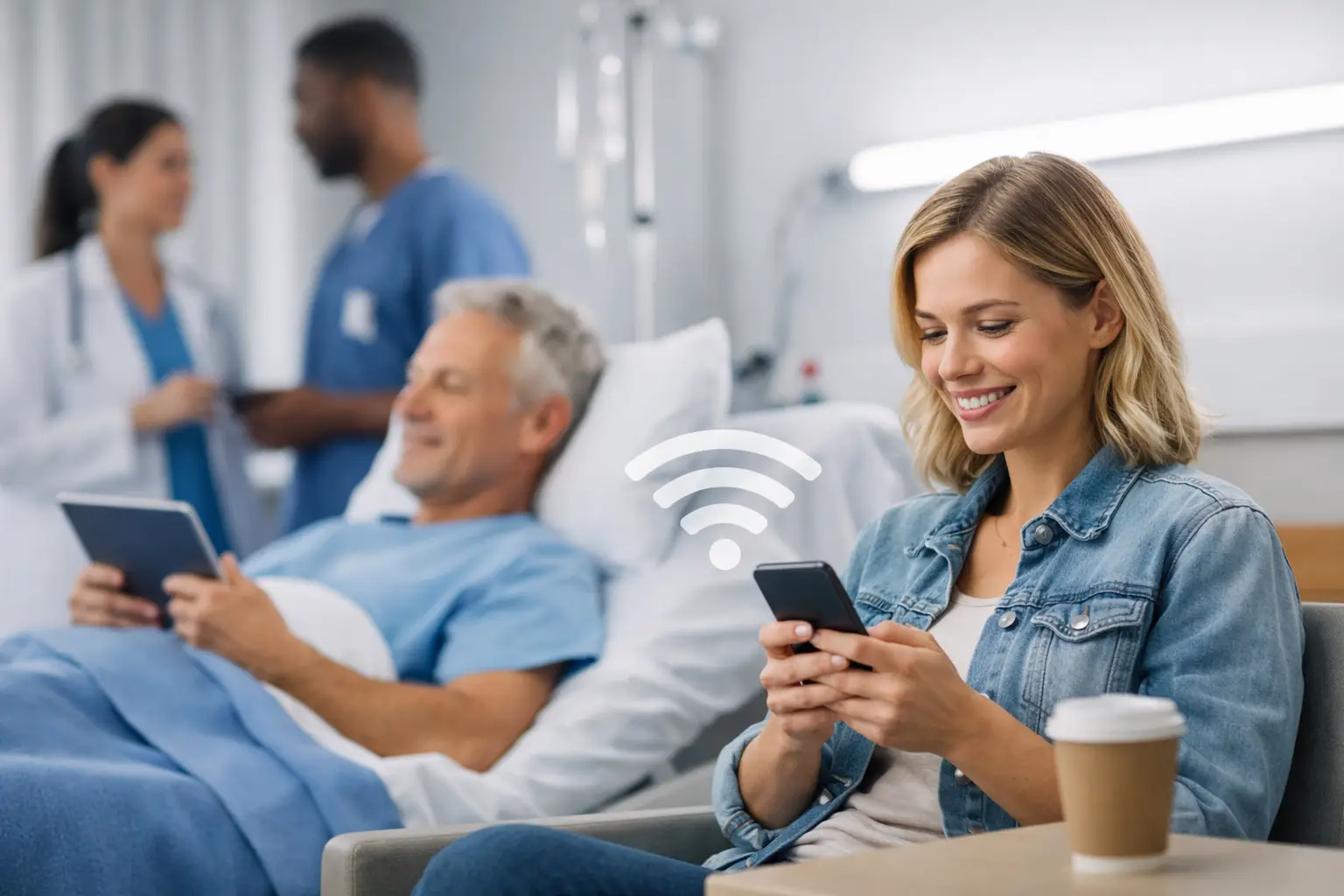
A waiting room is one of the few places where attention is high, anxiety is real, and communication gaps get noticed fast. That is exactly why hospital guest wifi communication deserves more strategic thinking than a basic free internet offering. In a hospital setting, guest Wi-Fi can support patient families, improve service visibility, reduce front-desk pressure, and create a more organized communication path across the visit.
Most hospitals already provide guest Wi-Fi because people expect it. The missed opportunity is treating it as a utility instead of a communication channel. When guest access is connected to a captive portal, consent-based data capture, and automated messaging, the network becomes more than connectivity. It becomes an operational tool that helps hospitals communicate at the right moment, on the right device, with far less friction.
Why hospital guest wifi communication matters
Hospitals manage a difficult communication environment. Patients, visitors, and outpatient guests all need different information. Some want directions to a department. Some need cafeteria hours. Some need parking guidance, appointment reminders, or updates about available services. At the same time, staff are already stretched and cannot answer the same routine questions all day.
A well-designed hospital guest wifi communication strategy addresses this problem directly. Instead of forcing every interaction through reception desks or printed signage, hospitals can deliver relevant messages through the Wi-Fi login flow and follow-up channels such as email, SMS, or WhatsApp where appropriate and consented.
This matters for three practical reasons. First, it improves the visitor experience in a setting where stress is already high. Second, it reduces manual communication workload. Third, it gives hospital operators better visibility into on-site engagement, message performance, and recurring visitor behavior.
For marketing and operations leaders, there is also a larger shift happening. Third-party targeting is less reliable, paid media costs continue to rise, and first-party data has become more valuable. Hospitals may not think about guest Wi-Fi in the same way a retailer or hotel does, but the same principle applies. If people are already on-site and connecting, that touchpoint should do more than authenticate devices.
What effective hospital guest wifi communication looks like
The strongest systems are simple for visitors and useful for operators. A guest should be able to connect quickly, understand what they are agreeing to, and receive information that feels relevant rather than promotional.
That starts with the captive portal. Instead of a generic password screen, the portal can collect basic first-party data with proper consent, present terms clearly, and segment users by location, purpose, or visit type. A hospital with multiple departments or campuses can use different login experiences for outpatient clinics, emergency waiting areas, maternity wards, and public common spaces.
From there, communication can become more targeted. A visitor connecting near outpatient imaging may receive directions, expected wait information, parking validation details, and post-visit resources. Someone in a maternity unit might receive visiting hours, cafeteria access information, and optional family updates. A person in a general lobby may see hospital services, pharmacy information, or guidance for scheduling future appointments.
The point is not to flood people with messages. The point is to replace generic communication with context-aware communication.
Where hospitals see the operational value
In many facilities, guest questions follow predictable patterns. People ask where to go, how long they may need to wait, whether there is food nearby, how to access patient support services, and what to do next after a visit. These are not complex problems, but they consume staff time at scale.
Guest Wi-Fi can absorb part of that load. Hospitals can use login pages and triggered follow-up messages to answer common questions before they become interruptions. They can also use a customized concierge flow through WhatsApp for visitor support, directions, department information, and service prompts when that aligns with privacy and compliance requirements.
This does not replace frontline staff. It supports them. That distinction matters. In healthcare settings, communication technology works best when it reduces low-value repetition and leaves higher-value interactions to people.
There is also value in campaign coordination. Hospital marketing teams often promote screenings, wellness programs, specialty clinics, donor initiatives, or community events. Guest Wi-Fi offers a measurable on-site channel for presenting those services to a relevant audience that is already engaging with the facility.
The data advantage without making the experience heavy
Hospital operators are right to be cautious about data collection. Healthcare environments require careful handling of privacy, consent, and compliance. That is why hospital guest wifi communication should focus on permission-based first-party data and operational relevance, not aggressive marketing tactics.
A practical setup usually captures only what is needed for the use case. That may include name, email, mobile number, language preference, or visit segment, depending on the environment and the consent model. The goal is not to turn a hospital login into a long registration form. If the sign-in process becomes cumbersome, adoption drops and frustration rises.
The right balance depends on the facility. A large hospital network with outpatient service lines may benefit from segmentation and remarketing workflows. A smaller regional hospital may prioritize ease of access, wayfinding, and visitor support over deeper automation. Both approaches can be effective if they match the organization’s priorities.
What matters is measurability. Once the network is tied to analytics, hospitals can see connection volume, repeat visitation trends, campaign engagement, portal conversion rates, and location-level usage patterns. That visibility helps operators make better communication decisions instead of relying on assumptions.
Common use cases for hospital guest wifi communication
The most effective use cases are the ones that solve immediate communication friction. Appointment-related reminders, visitor guidance, department-specific announcements, parking instructions, and cafeteria updates are obvious examples because they remove confusion during the visit itself.
Beyond that, hospitals can use guest Wi-Fi as part of a broader patient engagement and community outreach strategy. A captive portal can support health campaign awareness, promote service lines such as urgent care or imaging, and encourage enrollment in newsletters or community programs. Follow-up messaging can support satisfaction surveys, service education, or future appointment prompts where appropriate.
There is also value for multi-location systems. If a hospital group operates multiple campuses, clinics, or specialty centers, guest Wi-Fi creates a consistent communication layer across locations while still allowing local customization. That means brand consistency for the organization and more relevant messaging for each site.
What to get right before deployment
The technology is only one part of the outcome. Execution matters more.
First, the login experience must be fast. In a hospital, people connect because they need access now. If the portal is slow, confusing, or asks for too much information upfront, it will create resistance immediately.
Second, messaging should be role-aware and location-aware. A visitor, an outpatient guest, and a patient family member have different needs. Sending the same content to all of them weakens the value of the system.
Third, the deployment has to work with existing infrastructure. Hospitals often have mixed hardware environments, layered networks, and strict IT policies. A cloud-managed platform with remote configuration and compatibility across multiple access point brands is usually a more realistic fit than a rip-and-replace approach.
Fourth, privacy governance cannot be treated as an afterthought. Hospitals need clear consent language, sensible data retention policies, and internal alignment between IT, marketing, and compliance teams. The right system should make those controls manageable, not harder.
Why this is becoming a strategic channel
For many hospitals, guest Wi-Fi has been parked under IT as a convenience service. That made sense when the only goal was internet access. It makes less sense now.
Today, communication performance affects patient satisfaction, visitor experience, staff efficiency, and how effectively hospitals promote services across their communities. A guest network that can capture first-party data, trigger real-time messaging, segment audiences, and support follow-up communication is no longer just infrastructure. It is part of the hospital’s communication stack.
That shift is especially relevant for operators looking to do more with existing assets instead of adding another disconnected platform. Guest Wi-Fi is already in the building. The opportunity is to make it measurable, automated, and aligned with operational goals.
For hospitals that want a practical path forward, the best approach is not to start with every feature. Start with the communication problems that create the most friction, then build from there. When hospital guest wifi communication is designed around visitor needs and business outcomes, even a routine login screen can become a better way to inform, support, and strengthen every visit.
The hospitals that get this right will not necessarily be the ones with the most technology. They will be the ones that use a familiar touchpoint to communicate more clearly when people need it most.
Comments are closed