
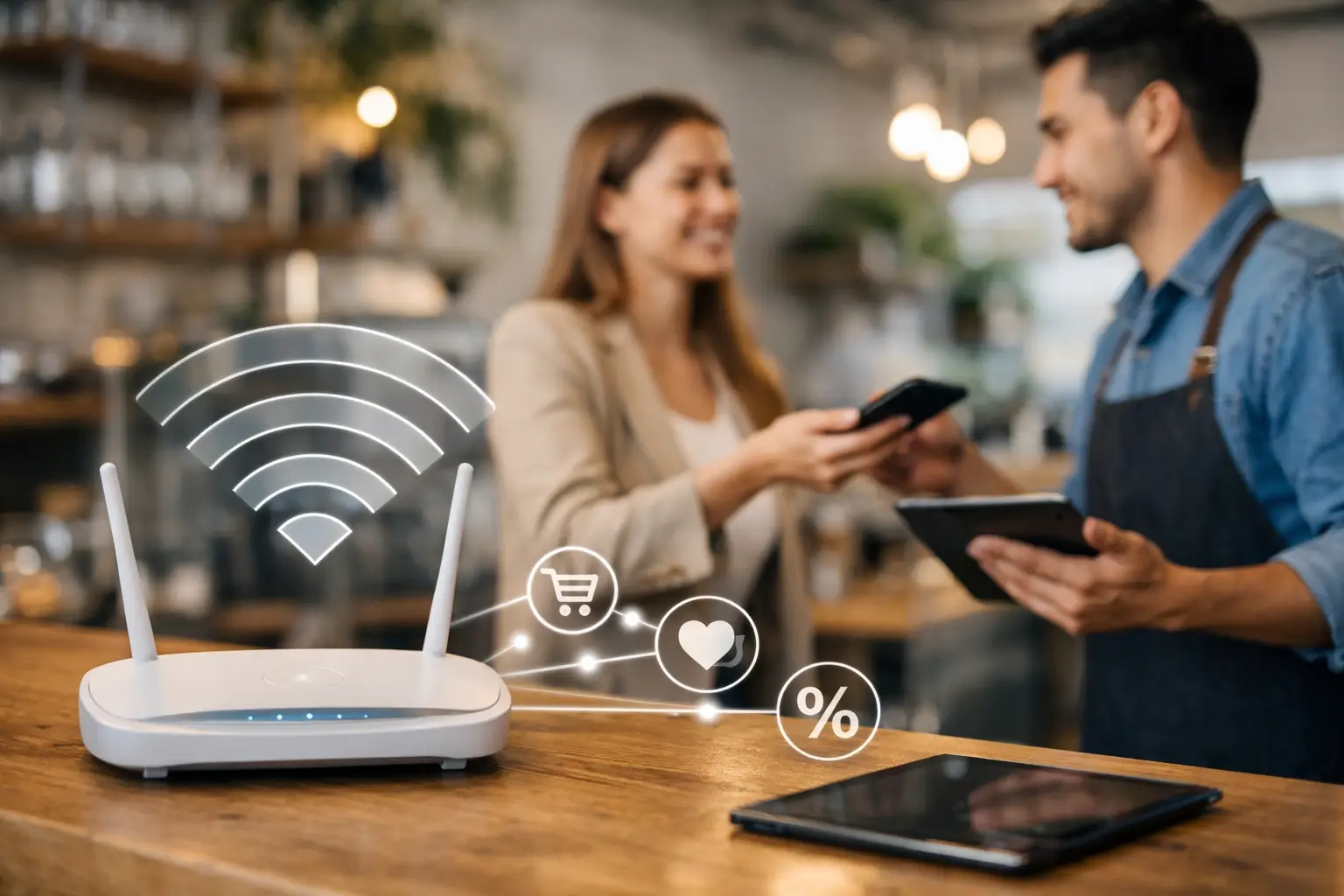
A guest asks for the Wi-Fi password, connects in seconds, and walks away thinking they just got internet access. From the business side, that same moment can become a first-party data opportunity, a remarketing trigger, and the start of an automated customer journey. That is the practical answer to how does wifi marketing work: it turns guest Wi-Fi from a utility into a marketing channel.
For hotels, restaurants, retail stores, clinics, malls, and other venue-based businesses, this matters because foot traffic is expensive to earn and easy to lose. If a visitor comes on site and leaves without joining a loyalty program, following your brand, or making a repeat purchase, that value often disappears. WiFi marketing helps close that gap by connecting physical visits with digital follow-up.
How does WiFi marketing work in practice?
At the center of WiFi marketing is a captive portal. Instead of giving every guest a shared password and no further interaction, the business presents a branded login page before internet access is granted. That page can ask guests to sign in with an email address, phone number, social account, room number, loyalty credentials, or a custom form based on the business model.
Once the guest logs in, the platform records permitted customer data and session details. Depending on the setup, that can include visit frequency, dwell time, location, device behavior, consent preferences, and campaign source. The Wi-Fi connection itself is the entry point, but the real value comes from what happens after authentication.
The platform can immediately place that visitor into a defined audience segment. A first-time café guest might receive a welcome offer. A retail shopper who visited twice in one month might enter a repeat-visitor campaign. A hotel guest can receive pre-arrival, on-property, and post-stay communication through email, SMS, or WhatsApp. The system is not just collecting contact details. It is organizing on-site behavior into usable marketing logic.
The core components behind WiFi marketing
A functioning WiFi marketing system usually combines hardware compatibility, cloud software, analytics, and campaign automation. The guest sees a login page. The operator sees a dashboard that turns traffic into profiles, segments, and triggered actions.
The first layer is network access control. This is what routes users through a branded captive portal rather than a generic router splash page. The second layer is data capture and consent management, which determines what information can be collected and how it can be used. The third layer is marketing execution, where email flows, SMS campaigns, WhatsApp outreach, retargeting audiences, and promotional messages are activated based on visitor behavior.
A more mature setup also includes integrations with ad platforms and pixels. That allows businesses to retarget audiences on channels such as Google and Facebook after the on-site visit. If acquisition costs are rising, this is where WiFi marketing becomes especially valuable. You are no longer relying only on paid traffic to bring people back. You are using first-party customer data generated inside your own venue.
What happens after a guest connects?
This is where many buyers underestimate the model. The Wi-Fi login is not the end of the process. It is the start of a communication workflow.
A restaurant can trigger a same-day thank-you message with a bounce-back offer for the next visit. A retailer can identify customers who return often and send product-focused campaigns to a higher-intent segment. A hospital or clinic can use guest Wi-Fi to improve visitor communication while keeping outreach relevant and compliant with its policies. An airport or transit operator can use multilingual login pages and location-based messaging to support both passenger experience and commercial promotions.
Some businesses also use concierge-style automation through WhatsApp to handle questions, direct customers to services, promote upgrades, or support bookings. That is especially useful in hospitality and large venues where response speed affects revenue and guest satisfaction.
The key point is that the Wi-Fi session becomes a trigger for timely, contextual communication. That is different from a static email list built months ago with no connection to actual foot traffic.
Why businesses invest in WiFi marketing
Most venue-based businesses already pay for internet infrastructure. The issue is that standard guest Wi-Fi usually produces no measurable marketing return. It serves customers in the moment, but it does not help the business understand who visited, who came back, or who should receive follow-up.
WiFi marketing changes that economics. It creates a lower-cost path to customer re-engagement because the business can communicate with people who have already been on site. It also improves segmentation. Instead of sending the same offer to every contact, operators can tailor messages based on visit history, location, frequency, and intent signals.
This has direct effects on revenue performance. Better targeting tends to improve conversion rates. More first-party data reduces dependence on broad paid advertising. Faster follow-up increases the chance of a second visit while the experience is still fresh. For multi-location businesses, the visibility is even more useful because they can compare traffic and engagement patterns across sites.
Where WiFi marketing performs best
The model works best where there is steady guest traffic and repeat-visit potential. Hotels use it to support guest communication, upsells, and post-stay remarketing. Restaurants use it to build repeat visits and local loyalty. Retail stores use it to connect offline shoppers with digital campaigns. Healthcare environments use it to improve communication with patients and visitors. Public venues use it to manage high traffic volumes while gathering better operational and promotional insight.
That said, results depend on the customer journey. A quick-service location with short visits will approach login and messaging differently than a resort, mall, or dealership. The more the login experience fits the environment, the better the conversion. If the process is too long or intrusive for the context, login completion rates can suffer.
The trade-offs businesses should consider
WiFi marketing is effective, but it is not magic. The platform has to be configured around the venue, the audience, and the business objective.
If the login page asks for too much information too soon, customers may abandon the connection. If the business collects data but never builds useful automation, the system becomes a passive database instead of an active growth channel. If teams are unclear on compliance, consent, or messaging frequency, outreach can become ineffective or create friction.
There is also a technical side. Hardware compatibility, network stability, remote management, cloud deployment, and multi-site configuration all affect rollout success. Businesses with internal IT support may handle part of this themselves, while others benefit more from a provider that combines software with implementation support, training, and ongoing optimization.
This is one reason many operators prefer an end-to-end partner rather than piecing together captive portal tools, messaging systems, and ad integrations on their own. The faster path to ROI is usually the one that aligns network setup with campaign execution from day one.
How to measure whether it is working
The most useful metrics go beyond simple Wi-Fi usage. Businesses should look at login conversion rate, consented customer records captured, repeat visit behavior, campaign engagement, audience growth, and downstream sales impact.
For example, if a retail chain sees that stores using a branded portal and segmented follow-up produce stronger repeat traffic than stores using open Wi-Fi, that is meaningful. If a hotel captures more direct guest contact data and reduces reliance on third-party booking communication, that is meaningful too. The value comes from measurable customer communication, not just internet sessions.
A strong platform should make these results visible in a dashboard that operators and marketers can actually use. Data is only useful if it helps teams act faster, personalize better, and prove performance across locations.
How does WiFi marketing work as a long-term asset?
The best way to think about WiFi marketing is not as a one-time campaign but as infrastructure for customer acquisition and retention. Every day, your venue generates visitor intent. Without a system in place, most of that intent disappears after the visit. With the right setup, it becomes a growing first-party audience that can be segmented, nurtured, and reactivated.
That makes guest Wi-Fi more than a convenience feature. It becomes part of the marketing stack, the customer experience strategy, and the analytics layer behind smarter decisions. For operators trying to lower advertising waste and get more value from existing traffic, that shift is practical, not theoretical.
If your business already has guests connecting on site, the question is not whether the infrastructure exists. The question is whether it is doing enough for the business after the login screen disappears.
Comments are closed