
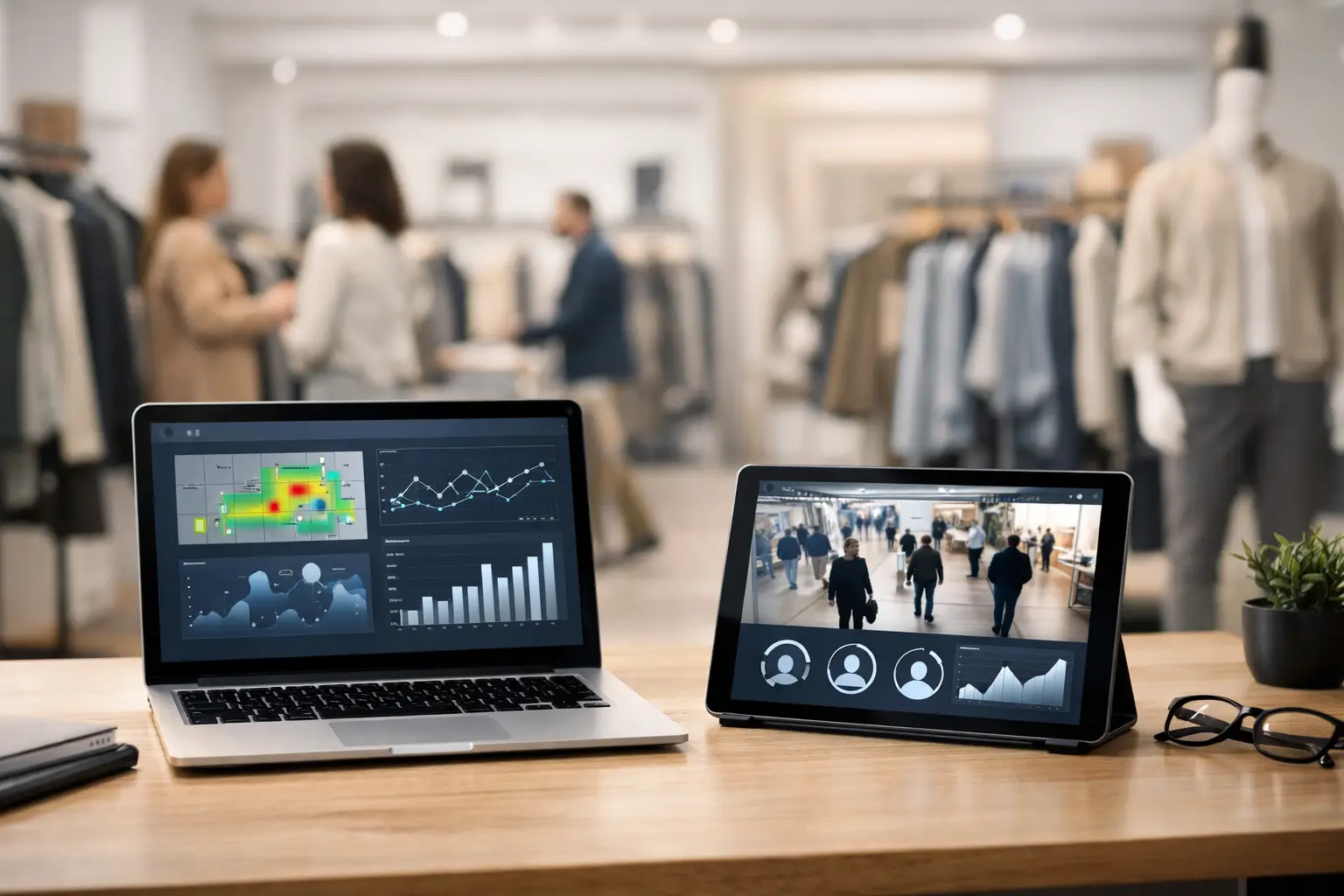
A store can report strong foot traffic and still miss the commercial opportunity. If visitors remain anonymous, operators cannot tell which campaigns brought them in, which audiences return, or how to follow up after they leave. The best retail visitor analytics platforms close that gap by turning physical visits into data that supports smarter staffing, merchandising, customer communication, and marketing spend.
For retail operators, the right choice is not simply the platform with the most sensors or the most detailed dashboard. It is the system that answers practical questions: How many people entered? When do visits peak? Which locations are underperforming? Did a promotion increase visits? Can the business identify and re-engage customers with permission after their visit?
What retail visitor analytics should actually deliver
Retail visitor analytics begins with footfall measurement, but footfall alone is a limited metric. A useful platform should show traffic by hour, day, location, and campaign period, allowing teams to compare performance across stores and make operational decisions with evidence rather than assumptions.
The stronger systems also connect behavior to outcomes. A retailer may need to understand dwell time in a department, conversion from entry to transaction, repeat visitation, queue conditions, or the relationship between online advertising and an in-store visit. The relevant mix depends on the store format. A specialty retailer may prioritize repeat-customer profiles and campaign attribution, while a high-volume mall location may care more about traffic patterns, peak periods, and staffing coverage.
Privacy matters just as much as insight. Platforms should provide clear consent flows where personal data is collected, support compliant data handling, and give customers an understandable reason to opt in. Anonymous counting and consent-based customer data serve different purposes. A mature retail analytics strategy often uses both.
The best retail visitor analytics platforms by use case
There is no universal winner because the underlying technologies solve different problems. The following platform categories are the most relevant for retailers deciding how to measure visits and activate customer data.
WiFi Marketing for visitor data and follow-up campaigns
Guest Wi-Fi analytics is especially valuable for retailers that want to move beyond anonymous counting. When a visitor joins a branded Wi-Fi network through a consent-based captive portal, the business can collect first-party information, build audience segments, and trigger communications after the visit.
Wifi Marketing is designed around that commercial workflow. Its platform combines guest Wi-Fi access, customer data capture, real-time messaging, email automation, SMS and WhatsApp outreach, and remarketing audiences. Rather than treating Wi-Fi as a basic amenity, it turns existing connectivity into a customer acquisition and retention channel.
This approach is a strong fit for retailers with repeat purchase potential, multi-location brands, shopping centers, and store concepts that benefit from loyalty building. For example, a retailer can welcome a first-time visitor, segment customers by location or visit frequency, then send a targeted offer after the visit. The trade-off is that Wi-Fi data depends on guests choosing to connect, so it should not be the only source used for total door-count accuracy.
RetailNext for in-store behavior analysis
RetailNext is associated with in-store analytics that help retailers evaluate shopper movement, traffic, dwell, and conversion. Its model is suited to organizations that want to understand how shoppers use the physical environment, including how activity changes by zone, department, or store layout.
This type of platform can be useful when merchandising and operations teams need detailed physical-store intelligence. It may help a retailer test whether a display draws attention, whether fitting rooms create friction, or whether a layout change affects conversion.
The consideration is implementation scope. Rich behavioral analytics can require careful planning around hardware, store conditions, integration with point-of-sale data, and internal ownership of the reporting process. It delivers more value when teams have a clear operational use for the findings.
Sensormatic Solutions for enterprise traffic and performance data
Sensormatic Solutions is commonly considered by large retailers looking for people-counting and store-performance capabilities across sizable portfolios. Enterprise traffic data can support conversion analysis, staffing planning, location benchmarking, and broader loss-prevention or operational initiatives depending on the deployment.
For a national retailer, consistent counting methodology across many stores is a major advantage. Regional managers can compare traffic and conversion trends without relying solely on manual estimates or incompatible store-level tools.
The trade-off is that an enterprise deployment may be more than a smaller retailer needs. Businesses should confirm how easily the system connects with their point-of-sale, workforce, CRM, and marketing platforms. A highly accurate traffic count is useful, but its business value rises when it is combined with transaction and customer data.
Dor for simple people counting
Dor is a practical option for retailers that need straightforward footfall measurement without a large analytics implementation. Its approach is often appealing to smaller operators that want to track entries, compare busy periods, and calculate basic conversion rates using traffic and sales figures.
This can be enough for a boutique, pop-up concept, or local chain that primarily needs dependable store traffic data. It also gives owners a clearer way to evaluate whether local marketing activity creates more visits.
However, simple counting platforms generally do not create consented customer profiles or campaign audiences on their own. Retailers that want automated post-visit engagement will need a separate customer data and communications layer.
Density for occupancy and space utilization
Density is most relevant when occupancy, capacity, and space utilization are central concerns. While it can support visitor intelligence, its value proposition extends beyond traditional retail footfall reporting. Large stores, mixed-use venues, and organizations managing complex physical spaces may use occupancy information to make facilities and staffing decisions.
For a conventional retail store focused on conversion and customer re-engagement, this may be more capability than necessary. For a venue with multiple entrances, shared areas, event traffic, or service bottlenecks, occupancy insights can be highly actionable.
How to choose the right platform
Start with the decision you need to improve. If the issue is store staffing, traffic counts and hourly patterns may be sufficient. If the goal is to improve layout, visual merchandising, and conversion, behavioral and zone-level analytics may be more appropriate. If the priority is lowering reacquisition costs, building first-party audiences, and bringing customers back, consent-based Wi-Fi marketing should be part of the evaluation.
Next, assess data integration. Visitor numbers become much more useful when paired with point-of-sale data. A retailer can calculate conversion by dividing transactions by visits, then investigate why one store converts better than another. Adding campaign data can reveal whether a paid social campaign drove qualified visitors rather than only more traffic.
Retailers should also examine deployment realities. Ask whether the platform works with existing network infrastructure, what hardware is required, how locations are configured, and who will train staff. A platform that appears sophisticated but requires extensive manual intervention can lose momentum after launch. Remote configuration, cloud reporting, multi-location controls, and implementation support are often more valuable than an impressive feature list.
Finally, define success before signing a contract. A useful pilot might target an increase in known customer profiles, a measurable lift in repeat visits, improved conversion during peak hours, or a reduction in wasted promotional spending. This gives the retailer a business case that goes beyond collecting more data.
Build a connected view of the store visitor
The most effective retail analytics stack does not force one tool to do every job. People counting can establish total traffic. Point-of-sale data can reveal conversion. Guest Wi-Fi can create permission-based customer profiles. Email, SMS, WhatsApp, and remarketing can turn those profiles into timely follow-up.
That connected view changes the conversation from “How many people came in?” to “Which visitors became customers, what brought them back, and what should we do next?” For retailers facing higher acquisition costs and less predictable walk-in demand, that is the measurement that supports growth.
No responses yet