
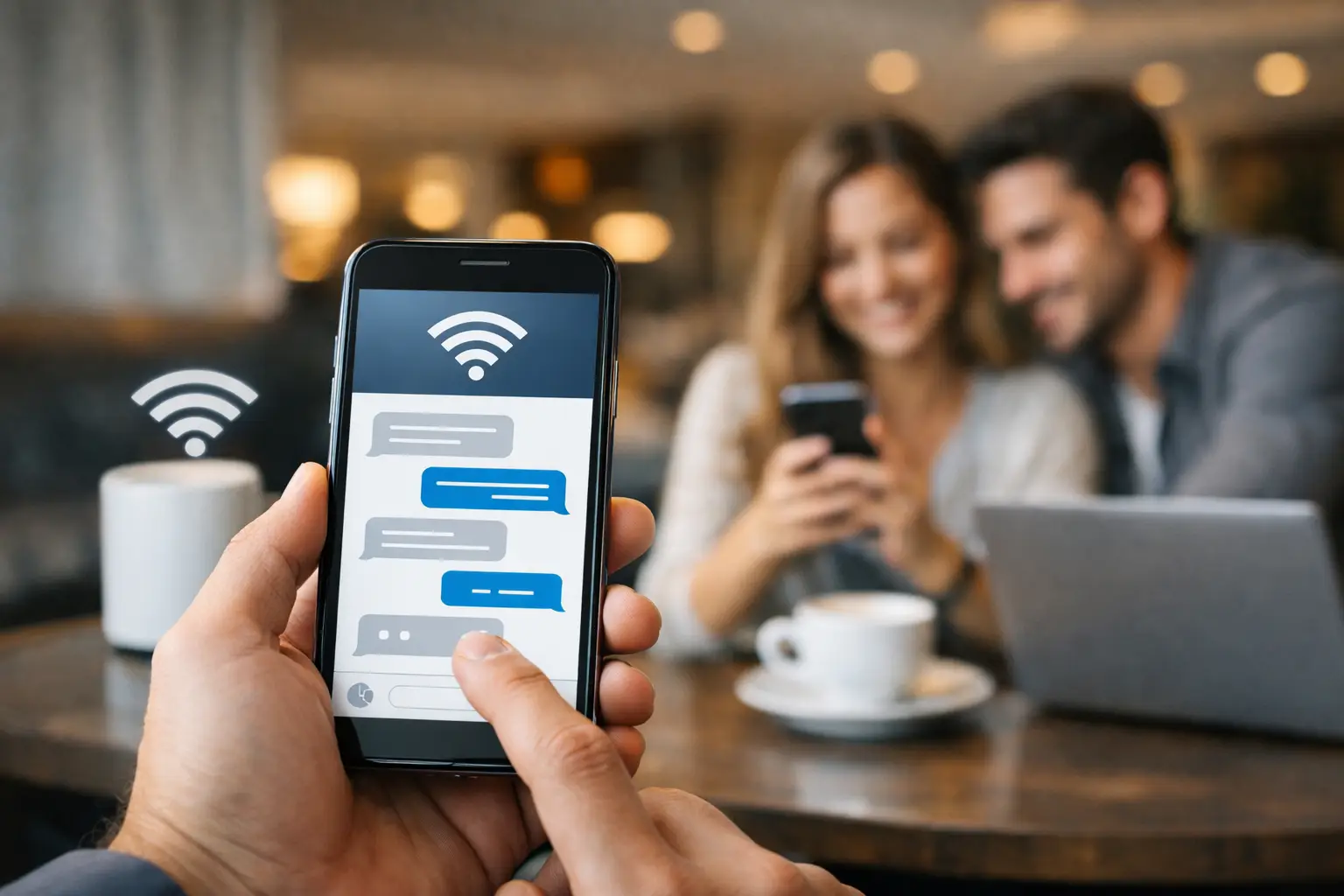
A guest connects to your Wi-Fi, enters a phone number, and walks into your business already closer to a second visit. That is the practical value of sms automation for guest wifi. It turns a utility you already provide into a measurable communication channel that supports acquisition, retention, and repeat sales without adding friction to the customer experience.
For businesses with steady foot traffic, this matters more than ever. Paid media costs keep rising, third-party data is less reliable, and many operators still have no structured way to follow up with people who visit in person. Guest Wi-Fi fills that gap when it is connected to SMS workflows that are timely, permission-based, and tied to real business goals.
What sms automation for guest wifi actually does
At a basic level, guest Wi-Fi gives you a point of entry. A captive portal collects customer data, secures consent, and identifies who is on-site. SMS automation takes that event and turns it into action.
That action might be a welcome message sent minutes after login, a bounce-back offer sent the next day, or a loyalty prompt triggered after a customer’s third visit. Instead of treating every visitor the same, businesses can use visit frequency, location, dwell time, and profile data to send relevant messages automatically.
The commercial value is straightforward. You collect first-party data at the moment of a real-world visit, segment it based on behavior, and follow up through a channel with high open rates. For operators who want more from existing infrastructure, that is a far better outcome than offering free Wi-Fi with no visibility and no follow-up.
Why SMS works so well in guest Wi-Fi environments
Email still has a place, and paid remarketing can be effective, but SMS has one major advantage in physical venues. It gets seen quickly. That speed makes it useful for time-sensitive campaigns tied to an on-site visit.
A restaurant can send a lunch return offer before the next business day. A retail store can follow up after a weekend promotion while intent is still fresh. A hotel can automate service messages that improve guest experience during the stay, then shift into post-stay re-engagement after checkout.
That does not mean every business should lead with aggressive texting. It depends on the customer relationship and the context. For a hospital or airport, the value may be more operational, such as helpful updates or service notices. For a boutique retailer, it may be promotional. The strongest programs match message type to customer expectations.
How sms automation for guest wifi supports revenue goals
Most venue operators do not need another messaging tool. They need a system that connects real visits to real outcomes. That is where guest Wi-Fi based automation stands out.
When a customer joins Wi-Fi, their session can trigger workflows based on who they are and what they do next. A first-time visitor might receive a welcome incentive. A repeat visitor might get a loyalty message. Someone who has not returned in 30 days might enter a win-back campaign. These are not broad campaigns built on assumptions. They are actions tied to observed behavior.
This improves marketing efficiency in two ways. First, it lowers waste because messages are based on actual foot traffic rather than rented audiences. Second, it gives teams cleaner attribution. If you know when a customer visited, when they received a message, and whether they returned, campaign performance becomes easier to measure.
For multi-location brands, this becomes even more valuable. They can compare response rates by store, region, campaign, or customer segment and adjust quickly. Messaging stops being guesswork and starts functioning like an operational growth channel.
What a strong setup looks like
The best results usually come from treating guest Wi-Fi and SMS as part of one system, not two separate tools. The Wi-Fi login experience should collect the right data, set expectations clearly, and route contacts into automation with clean tagging and consent records.
That means the captive portal matters. If the login flow is clunky, data quality drops. If consent language is vague, compliance risk goes up. If the platform cannot segment users properly, your automation becomes blunt and less effective.
A strong setup typically includes branded login pages, mobile-friendly data capture, configurable consent, and integrations with CRM, email, ad platforms, and analytics. Cloud-based management also matters, especially for businesses with multiple locations or mixed hardware environments. Remote configuration and centralized reporting reduce operational overhead and make campaign changes easier to deploy.
This is also why implementation support matters. Many businesses have Wi-Fi hardware in place but no strategy for turning it into a customer communications asset. The right partner helps align network configuration, portal design, automation logic, and reporting so the system produces business value, not just connectivity.
Use cases by industry
Hotels are a strong fit because guest Wi-Fi spans the full customer lifecycle. SMS can support pre-arrival instructions, in-stay concierge communication, upsell offers, and post-stay review or rebooking prompts. When paired with intelligent WhatsApp concierge capabilities, the experience becomes even more useful for service delivery.
Restaurants often benefit from speed and repeat traffic. Wi-Fi triggered texts can drive midweek visits, lunch specials, loyalty signups, and targeted offers based on visit patterns. The key is restraint. Too many messages can hurt just as quickly as no follow-up at all.
Retailers can use guest Wi-Fi data to identify store visitors, segment by frequency, and promote relevant offers after the visit. That is especially useful when ad costs are high and store traffic needs to convert into owned audience growth.
Transportation hubs, malls, airports, and public venues usually need scale and flexibility. Their value may come from sponsorship campaigns, tenant promotions, customer service alerts, or segmented messaging by location zone. In these environments, the platform has to be reliable across large volumes and multiple stakeholders.
Healthcare settings require more care around message type, privacy, and consent, but guest Wi-Fi can still support service communication, patient experience updates, and operational messaging when configured correctly.
Trade-offs and mistakes to avoid
SMS is powerful, but it is not forgiving. If your data capture is weak, your consent process is unclear, or your messaging is too frequent, performance will suffer. Customers respond well to relevance and timing. They do not respond well to generic blasts.
Another common mistake is treating Wi-Fi login as a one-time lead form. That misses the larger opportunity. The real value comes from linking visits, profiles, segmentation, and ongoing automation across channels. SMS works best when it is part of a broader first-party data strategy that may also include email, paid remarketing, and loyalty campaigns.
There is also a technical trade-off. A low-cost guest Wi-Fi setup may provide internet access, but not the controls, integrations, or analytics required for real marketing automation. Businesses that want measurable outcomes usually need more than access points and a splash page. They need a platform that can capture data accurately, automate messaging reliably, and report on performance in business terms.
Measuring whether it is working
The right metrics depend on the venue, but most operators should look beyond list growth alone. Wi-Fi logins and phone number capture are only the starting point. What matters is whether those contacts turn into repeat visits, higher spend, improved retention, or lower customer acquisition costs.
Useful indicators include opt-in rate, message delivery, click-through rate, redemption rate, repeat visit frequency, time-to-return, and revenue influenced by automated campaigns. Multi-location businesses should also compare these metrics across sites to identify where messaging, staffing, or local offers need adjustment.
This is where an integrated approach pays off. When guest Wi-Fi, messaging automation, and reporting sit in one operational framework, teams can move faster and make better decisions. That is the difference between collecting contacts and building a real customer engagement engine.
For businesses with physical locations, sms automation for guest wifi is not just a messaging feature. It is a way to convert foot traffic into owned audience growth and ongoing revenue using infrastructure you already have. When the strategy, technology, and execution are aligned, every login becomes a chance to start a more profitable customer relationship.
Comments are closed