
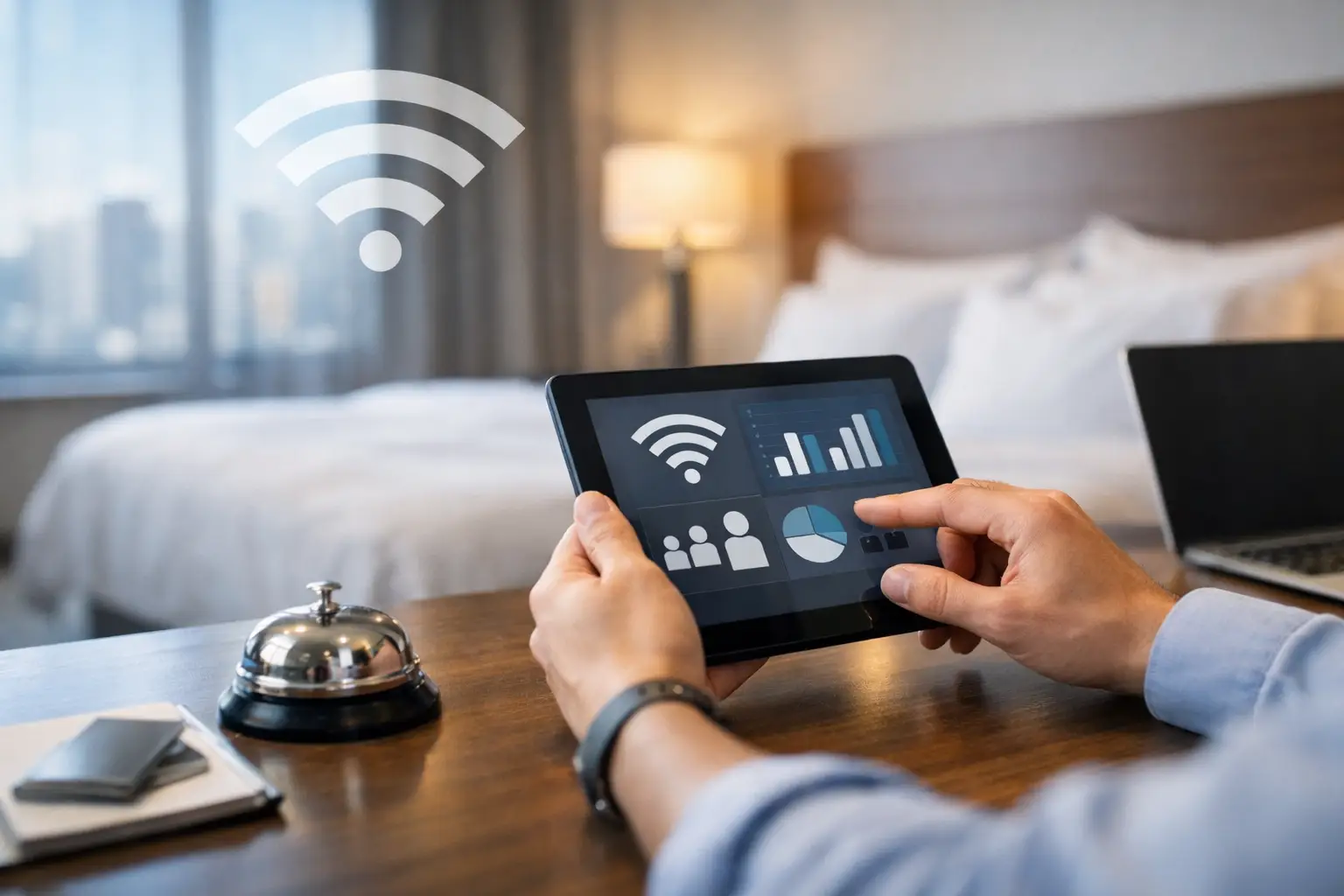
A guest checks in after a long flight, connects to the property Wi-Fi, and disappears into your network like every traveler before them. If that interaction starts and ends with internet access, the hotel misses one of the most useful marketing moments on site. A hotel wifi marketing platform changes that by turning guest connectivity into a measurable channel for data capture, communication, and repeat revenue.
For hotel operators, this is not about adding another piece of software for the sake of it. It is about getting more value from infrastructure you already provide, while improving how you welcome guests, promote on-property services, and stay in touch after checkout. Done well, the platform supports both the guest experience and the commercial goals behind occupancy, ancillary revenue, and loyalty.
What a hotel wifi marketing platform actually does
At a basic level, a hotel wifi marketing platform sits between the guest and the internet connection. Instead of offering anonymous access, it presents a branded captive portal where guests log in, accept terms, or identify themselves through email, social login, room number, or other approved methods.
That first step matters because it creates a direct line between a physical visit and a digital profile. Once a guest is identified, the hotel can segment audiences, automate follow-up, and measure behavior in ways that standard guest Wi-Fi cannot support.
The real value is not the login screen itself. It is what happens after. A capable platform can trigger welcome messages, collect first-party data, pass audiences into email and SMS workflows, support remarketing, and help properties promote upgrades, dining, spa offers, late checkout, and future stays.
In practical terms, it turns Wi-Fi from a utility expense into a customer communication asset.
Why hotels are putting more pressure on first-party data
Hotels are operating in a more expensive marketing environment. Paid media costs are higher, third-party data is less reliable, and OTAs continue to pressure margins. At the same time, guests expect personalized communication and quick service across channels.
That combination makes first-party data more valuable than ever. A hotel wifi marketing platform helps collect it at a moment when guest intent is high and participation is natural. People want access, and they are already on site. This creates a cleaner, more consent-based way to build audience data than many off-site acquisition tactics.
There is a trade-off, though. If the login experience is clunky, too intrusive, or poorly branded, it can create friction. Hotels need to balance data collection with ease of access. Luxury properties, limited-service hotels, resorts, and conference venues may all make different choices based on guest expectations and stay patterns.
The commercial use cases that matter most
For most hotels, the strongest case for adopting a platform is not Wi-Fi management. It is revenue performance.
A well-configured system can promote high-margin services during the stay. A guest connecting from the lobby might see a breakfast offer. A family near the pool area might receive a message about food and beverage service. Business travelers could be targeted with meeting room options or premium internet packages, depending on the property model.
After the stay, the same data can support retention campaigns. Instead of sending generic promotions to an unqualified database, the hotel can segment by visit frequency, dwell time, property location, or engagement behavior. That makes campaigns more relevant and usually more efficient.
This is also where operational teams start to see the difference between generic Wi-Fi and a purpose-built marketing platform. The goal is not simply to know that 500 people connected this week. The goal is to know who they were, what segments they belong to, and what actions you can take next.
What to look for in a hotel wifi marketing platform
Not every platform marketed to hospitality is built with the same depth. Some focus mostly on guest access. Others include the tools needed to support real marketing execution.
The first priority is branded captive portal flexibility. Hotels need more than a generic splash page. They should be able to tailor login flows by property, audience, campaign, or brand standard. A boutique hotel and a multi-location hotel group will have different requirements, and the platform should support both.
The second is data capture and segmentation. If the system only records a connection event, its marketing value is limited. Hotels need profile creation, audience tagging, repeat visit recognition, and the ability to organize contacts for future campaigns.
The third is automation. Manual follow-up does not scale, especially across multiple properties. A strong platform should support triggered email, SMS, and in some cases WhatsApp messaging based on guest behavior, timing, or location context.
The fourth is integration. Hotel teams already work across PMS environments, CRM tools, ad platforms, and reporting dashboards. The Wi-Fi layer should complement that stack, not create another silo. This is one reason implementation support matters as much as software features.
Finally, analytics need to be tied to business outcomes. Connection volume is useful, but hotels should also be able to track return visits, campaign engagement, upsell response, list growth, and audience quality. Without that, it becomes difficult to justify the investment beyond basic guest service.
Captive portal strategy is where many hotels underperform
The captive portal is often treated like a technical requirement when it should be treated like a conversion point. This is a mistake.
A portal should reflect the hotel brand, keep the process simple, and give guests a clear reason to engage. That might mean fast access with minimal fields for a premium property, or a more promotional entry flow for resorts and entertainment-driven venues. The right approach depends on guest expectations and what the hotel wants to achieve.
There is no single best format. Asking for too much information can reduce login completion. Asking for too little can limit downstream marketing value. The most effective hotel setups test the balance, monitor drop-off, and refine over time.
Automation matters more than one-time campaigns
Hotels rarely struggle to come up with messages. They struggle to send the right message at the right time without creating more manual work.
This is where a hotel wifi marketing platform becomes more than a data collection tool. Automation can support pre-arrival reminders, on-property promotions, post-stay review requests, rebooking campaigns, and win-back sequences for lapsed guests. Instead of relying on broad monthly blasts, teams can create workflows that respond to actual guest behavior.
For operators with lean marketing teams, this is often the biggest operational advantage. The platform keeps working after setup, especially when campaigns are tied to repeatable guest journeys.
Some providers go a step further with concierge-style messaging through channels like WhatsApp. That can be especially useful for hotels that want to blend service communication with promotion in a more conversational format.
Multi-property groups need consistency without losing flexibility
Independent hotels and hotel groups approach deployment differently. An independent property may want speed, simplicity, and direct control. A multi-property brand usually needs central visibility, standardized reporting, and governance across locations.
The right platform should support both local execution and centralized oversight. Corporate teams may want shared templates, brand controls, and roll-up reporting. Individual properties may still need flexibility for local offers, event promotions, or regional audience targeting.
This is where cloud-based deployment and remote configuration become especially valuable. Hotels do not want every property rollout to become a custom IT project.
Technology is only half the buying decision
Hotels often evaluate platforms based on features alone, but delivery matters just as much. Hardware compatibility, installation support, network configuration, dashboard training, and ongoing optimization all affect results.
That is why many operators prefer a partner model rather than a pure software vendor. A provider that can support setup, coordinate with network environments, and help shape campaigns reduces the burden on internal teams.
Wifi Marketing is positioned well in this area because the offer combines software, implementation support, automation, and revenue-focused use cases rather than stopping at guest access.
The right question is not whether you offer free Wi-Fi
Most hotels already do. The better question is whether that Wi-Fi is helping the business grow.
If your guest network only provides access, it is doing the minimum. If it captures first-party data, supports personalized communication, promotes on-site revenue, and improves retention, it starts paying back far beyond connectivity.
For hotels trying to lower acquisition costs and get more value from every stay, that shift is hard to ignore. The opportunity is already in the building. The next step is using it with more intent.
Comments are closed