
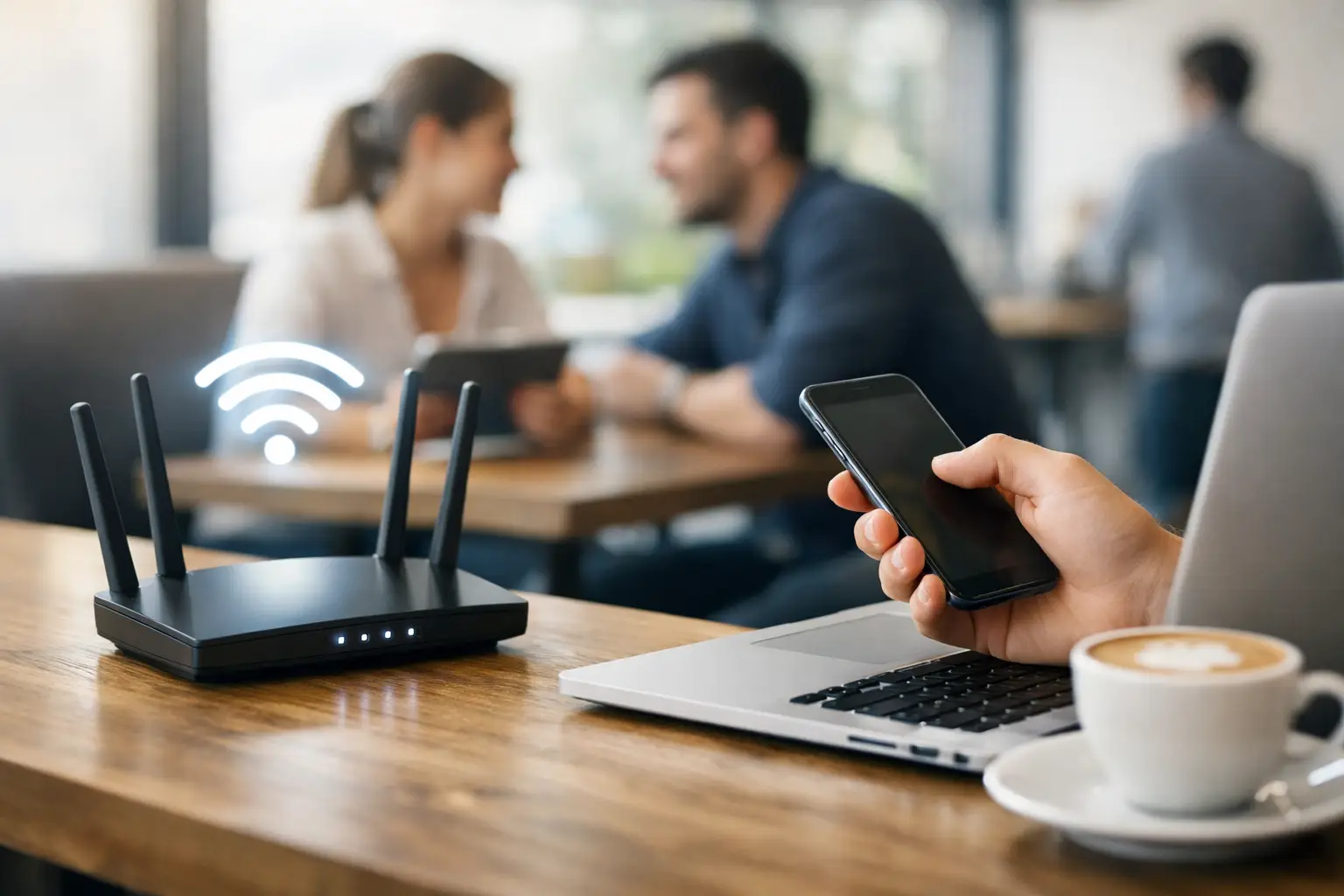
A guest asks for the Wi-Fi password, connects in seconds, and then disappears from your marketing radar forever. That is the default experience in most physical businesses. If you rely on walk-in traffic, that gap is expensive. What is WiFi lead generation? It is the process of turning guest Wi-Fi access into a system for capturing customer data, building first-party audiences, and following up with visitors after they leave.
For hotels, restaurants, retail stores, medical offices, malls, and transportation hubs, the value is straightforward. You already have people on-site. You are already paying for internet access. WiFi lead generation turns that existing infrastructure into a measurable acquisition and retention channel.
What is WiFi lead generation and how does it work?
WiFi lead generation uses a guest Wi-Fi login flow, usually through a captive portal, to collect permission-based customer information before internet access is granted. Instead of posting a shared password on a wall or handing it out at the counter, the business presents a branded login page. That page can ask for an email address, mobile number, social login, or a simple opt-in tied to your privacy and marketing permissions.
Once the visitor connects, their session can trigger a much broader marketing workflow. Their data moves into your CRM, email platform, SMS campaigns, audience segments, or remarketing tools. A one-time Wi-Fi connection can become a welcome message, a bounce-back offer, a loyalty campaign, a review request, or a retargeting audience.
That is the core difference between basic guest Wi-Fi and WiFi lead generation. One gives internet access. The other gives you a structured way to identify visitors, segment them, and market to them based on real-world visits.
Why businesses are paying attention now
For most customer-facing businesses, paid media has become more expensive while third-party tracking has become less reliable. At the same time, many companies still have limited visibility into who actually visits their locations. They may know transactions, but not always the broader audience of people who walk in, browse, wait, or use the space.
WiFi lead generation helps close that gap with first-party data. That matters because first-party data is information your business collects directly from customer interactions. It is more durable, more usable for personalization, and generally more valuable than rented audiences from external platforms.
There is also a practical advantage. You do not need to create a new customer behavior from scratch. Guests already expect to connect to Wi-Fi in many venues. If the access experience is simple and the value exchange is clear, data capture happens as part of a routine visit.
What data can WiFi lead generation collect?
The answer depends on the setup, the venue, and your compliance standards. In many cases, the most useful fields are the simplest ones: name, email address, phone number, location visited, time of visit, frequency of return visits, and campaign consent status.
A more advanced setup can also support behavioral segmentation. You may be able to identify new versus returning visitors, visitors by location, dwell patterns, campaign responses, and audience groups based on how often they come back. For multi-location operators, this becomes especially useful because it creates a more complete picture of customer movement across stores, properties, or venues.
The point is not to collect everything possible. The point is to collect the right data with permission and put it to work quickly.
What WiFi lead generation is not
It is not just a fancy login page. If the data goes nowhere and nothing happens after the connection, you have not built a lead generation system. You have built a gate.
It is also not a replacement for every other channel. Email, SMS, paid social, loyalty programs, point-of-sale data, and on-site service still matter. WiFi lead generation works best as a bridge between physical visits and digital follow-up. It strengthens your existing stack rather than replacing it.
And it is not equally valuable in every environment. A fast-turn coffee shop may prioritize simple data capture and repeat visit prompts. A hotel may focus on pre-arrival communication, upsells, and post-stay remarketing. A hospital or airport may care more about high-volume visitor communication and location-specific messaging. The same core system applies, but the use case changes.
The business case for WiFi lead generation
The strongest reason to invest in WiFi lead generation is not novelty. It is economics.
Customer acquisition costs continue to rise. If your business gets consistent foot traffic, every untracked visit is a missed chance to build a reusable marketing audience. WiFi lead generation lowers that waste by converting anonymous visitors into contactable leads.
It also improves retention. A customer who connected once can receive automated follow-up later, whether that means a next-visit incentive, a loyalty offer, a personalized message, or a reminder tied to their visit history. That kind of re-engagement is often more cost-effective than constantly buying new clicks from ad platforms.
Then there is measurement. When guest Wi-Fi is connected to analytics and campaign tools, you can see how many visitors connected, what data was captured, which segments responded, and how campaigns performed by location. That makes marketing less dependent on guesswork.
Common use cases by industry
In hospitality, WiFi lead generation can support guest acquisition before the stay and retention after checkout. A hotel can collect guest data through branded Wi-Fi access, send upsell offers during the stay, and continue communication later with promotions for return visits, events, or loyalty enrollment.
In restaurants and cafes, the value often centers on repeat business. A visitor connects once, receives a follow-up promotion a few days later, and comes back. Over time, operators can segment lunch customers, weekend visitors, or regulars and tailor outreach instead of sending broad, generic campaigns.
In retail, it helps bridge store traffic with digital remarketing. A shopper may browse without buying, but if they connected to Wi-Fi, the business still has a path to re-engage them through email, SMS, or ad audiences.
In healthcare waiting areas, transportation hubs, malls, and public venues, scale matters. These environments often serve large volumes of temporary visitors. WiFi lead generation creates a structured, compliant way to communicate with those audiences and understand usage patterns across time and location.
What makes a WiFi lead generation program effective?
The login experience has to be simple. If the portal asks for too much too early, completion rates drop. Businesses often make the mistake of treating guest Wi-Fi like a long-form lead form. That usually backfires. The better approach is to capture a small amount of high-value data, gain consent clearly, and continue the relationship through automated follow-up.
Branding also matters more than many operators expect. A clean, branded captive portal reassures users that they are connecting to a legitimate network and dealing with a real business. It also turns a utility moment into a brand touchpoint.
The real performance gains come from integration and automation. If contact details are captured but never synced to your marketing systems, the value stops at collection. If the Wi-Fi platform feeds email, SMS, WhatsApp, ad audiences, and analytics, the network becomes part of your marketing engine.
That is why implementation matters. Hardware compatibility, remote configuration, multi-location deployment, dashboard setup, consent management, and training all affect outcomes. For many businesses, the difference between mediocre results and strong ROI is not the portal itself. It is the quality of execution behind it.
Trade-offs and considerations
WiFi lead generation works best in venues where guests have a clear reason to connect. In some businesses, mobile data is fast enough that only a portion of visitors will bother. That does not make the model ineffective, but it does mean adoption rates vary by industry, visit length, and customer expectations.
Privacy and consent need to be handled carefully. The data is valuable only if it is collected transparently and used responsibly. Businesses need a clear opt-in process, sensible data policies, and campaign practices that respect the customer relationship.
There is also a balance between marketing ambition and customer experience. Too many pop-ups, too many fields, or irrelevant follow-up messages can reduce trust. The most effective programs feel useful and proportionate.
So, what is WiFi lead generation really worth?
At its best, it gives physical businesses something they often lack: a reliable way to convert on-site traffic into first-party marketing value. It takes an underused operational asset – guest Wi-Fi – and turns it into a source of leads, segmentation, automation, and revenue insight.
For operators trying to improve retention, reduce wasted foot traffic, and get more from their existing locations, that is a meaningful shift. The Wi-Fi network stops being a basic amenity and starts functioning like a measurable growth channel.
If your business serves customers in person, every connection is more than a login. It is a chance to start a conversation you can continue long after the visit ends.
Comments are closed