
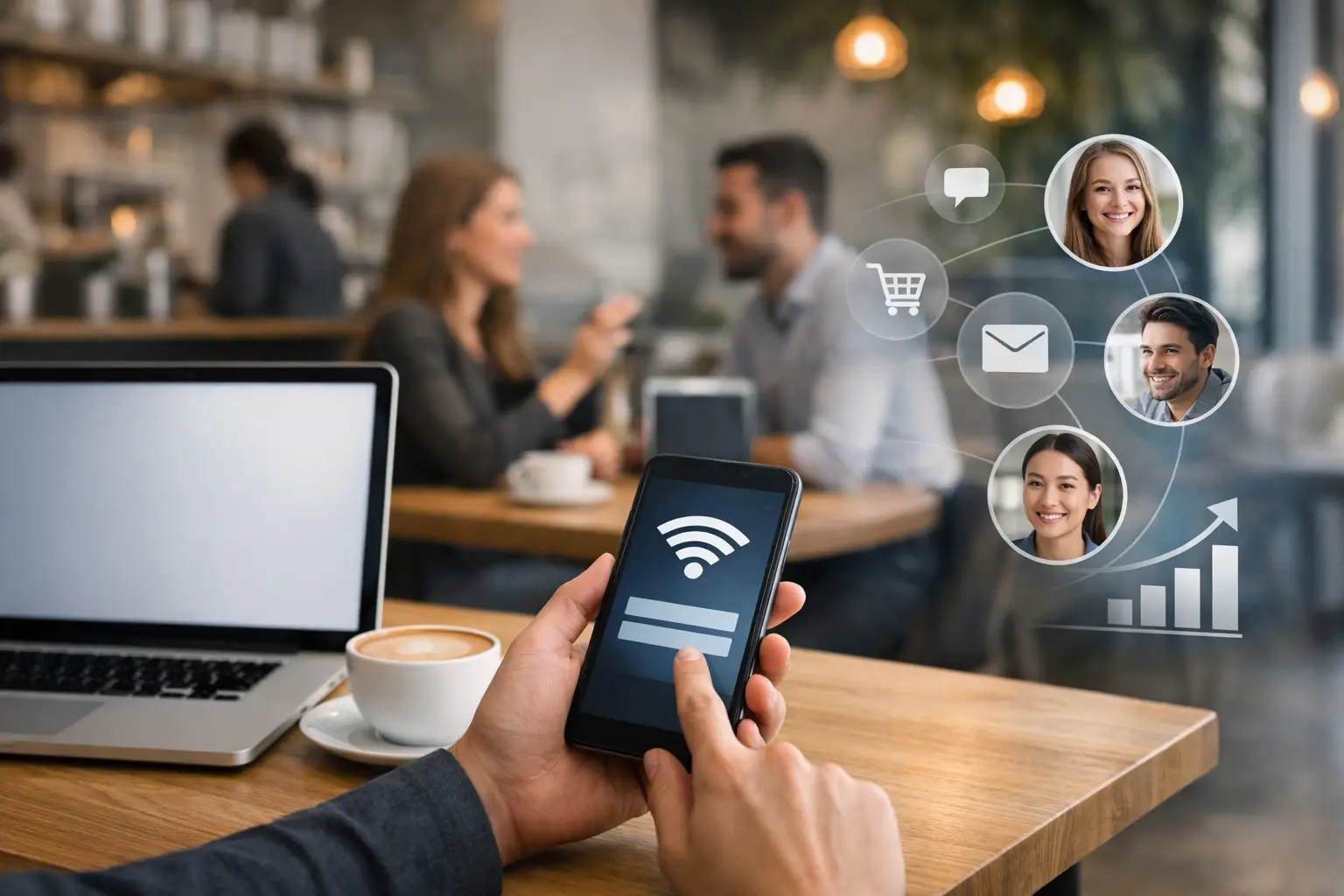
A guest joins your WiFi, stays for 45 minutes, makes a purchase, and leaves. For many businesses, that visit ends there. Knowing how to turn guest WiFi into a marketing channel changes that equation. The same connection can create a permission-based path to capture customer data, understand visit behavior, and send relevant follow-up messages after the customer has walked out the door.
Free WiFi is already an expected amenity in hotels, restaurants, retail locations, waiting rooms, and public venues. The opportunity is not simply to offer access. It is to use that access point to build a measurable first-party customer communication system without adding friction to the guest experience.
Start With the Right Goal for Guest WiFi
Guest WiFi should not be treated as an isolated IT expense. It can support customer acquisition, retention, loyalty, review generation, and remarketing, but only when the goal is clear before deployment.
A quick-service restaurant may use WiFi to build an opt-in list for lunch offers. A hotel may focus on improving the stay experience, communicating property information, and inviting guests to return. A retail store may want to identify repeat visitors and trigger a follow-up campaign when a shopper has not returned. An airport lounge, mall, or healthcare provider may prioritize service updates and visitor communication.
The objective determines what data you request, what messages you send, and how you measure results. Asking for too much information at login can lower connection rates. Asking for too little can leave marketing teams without a usable audience. In most cases, a simple login experience that captures an email address or mobile number, consent, and basic profile details is the practical starting point.
How to Turn Guest WiFi Into a Data Capture Channel
The central tool is a captive portal. This is the branded page visitors see before they receive internet access. Instead of connecting anonymously, a guest logs in through an email form, SMS verification, social sign-in option, voucher code, or another approved method.
A well-configured portal does more than display a logo. It establishes the value exchange: your guest receives convenient internet access, while your business receives permission to communicate under clearly stated terms. The page can also promote current offers, loyalty enrollment, event information, concierge support, or a customer survey.
Keep the experience focused. A guest who is trying to join WiFi at a restaurant table or hotel lobby does not want to complete a long registration form. Request only the information that supports a defined marketing action. For example, an email address supports automated email campaigns, while a mobile number may be more useful for time-sensitive messages through SMS or WhatsApp.
Consent language matters. Your portal should clearly explain how customer information will be used and provide appropriate opt-in controls for marketing communications. Compliance requirements vary by message channel, location, and business model, so operators should align portal forms and campaign practices with their privacy and communications policies.
Connect identity to real-world visits
The advantage of WiFi marketing is that it begins with a physical visit. When a customer returns and reconnects, the platform can recognize that behavior. This lets your team distinguish a first-time visitor from a returning customer and build segments based on visit frequency, location, device behavior, or other permitted data points.
For a multi-location brand, this can reveal whether customers visit one store repeatedly or move between locations. For a hotel group, it can help identify guests who have stayed at more than one property. Those insights are more actionable than a generic email list because they are connected to real visit patterns.
Build Follow-Up Around Customer Intent
Collecting contact details is not the finish line. It is the point at which your marketing can become more timely and relevant.
A basic workflow might send a welcome email shortly after a first WiFi login, followed by a targeted offer a few days later. A stronger program uses segmentation. First-time visitors may receive an introduction to your loyalty program. Frequent visitors may get a VIP offer or an invitation to leave a review. Customers who have not returned after a defined period may receive a reactivation message.
The best cadence depends on the venue. A coffee shop can reasonably promote a return visit within a few days. A hotel should avoid treating every guest like a daily retail customer and may focus on post-stay feedback, future booking incentives, or local concierge content. A hospital or public service venue must be especially careful to keep communication appropriate to the setting and the consent collected.
Real-time messaging can also improve the visit itself. A branded portal can present a same-day promotion, while an intelligent WhatsApp concierge can answer common questions about hours, services, directions, property amenities, or current offers. This reduces pressure on front-line staff while giving guests a faster way to get useful information.
Make WiFi Data Work With Your Existing Marketing Stack
A guest WiFi system has greater commercial value when it does not operate in a silo. Customer data should flow into the tools your marketing team already uses, such as a CRM, email platform, loyalty system, SMS platform, or advertising audience workflow.
This connection enables practical use cases. A customer who opts in through the portal can enter an automated email sequence. A segment of recent visitors can receive a WhatsApp message where consent supports it. Visitors who connected but did not make a known purchase can be included in a remarketing audience through supported tracking integrations such as Facebook Pixel or Google Pixel.
There is a trade-off here. More integrations can create more useful automation, but they also require clear ownership of data, consent, and campaign management. Before launching, decide which team owns the portal, who approves offers, how often lists synchronize, and what success metrics will be reviewed. Technology does not replace campaign discipline.
Measure Revenue, Not Just Connections
A dashboard showing thousands of WiFi logins may look impressive, but connection volume alone does not prove business value. Track the steps that tie guest access to commercial outcomes.
Useful performance measures include portal conversion rate, marketing opt-in rate, number of known versus anonymous visitors, repeat visit rate, campaign opens and clicks, redemption rate, and revenue attributed to offers or loyalty actions. For venues with multiple locations, compare performance by site. A low opt-in rate at one location may be caused by weak portal messaging, poor signal coverage, staff processes, or an audience that has different expectations.
Attribution will not always be perfect. A customer may receive an email offer and return without using a coupon. That does not mean the campaign had no impact. Use a combination of direct redemptions, repeat-visit trends, segment performance, and controlled campaign comparisons to make better decisions over time.
Get the Network Foundation Right
Marketing capability depends on reliable WiFi. If the network is slow, unstable, or difficult to join, customers will abandon the process before they ever see your portal. Your guest network should be separated from internal business systems, sized for expected device volume, and managed through hardware that supports captive portal configuration and analytics.
This is particularly relevant for hotels, large retail environments, malls, transportation venues, and healthcare facilities where many users may connect at once. Remote configuration and cloud-based management make it easier to maintain standards across locations, update campaigns centrally, and troubleshoot issues without requiring on-site technical work for every adjustment.
Hardware compatibility is also worth reviewing early. Some businesses can use existing access points; others need an upgrade to support the desired portal, authentication, analytics, and security requirements. A practical deployment partner can assess the network, configure the system, and train teams on dashboard use so marketing does not depend on an overextended IT department.
Avoid the Common Guest WiFi Mistakes
The most common mistake is offering free WiFi with no customer strategy behind it. The second is the opposite: creating a login form so demanding that guests choose mobile data instead. Effective programs balance ease of access with meaningful data collection.
Another frequent issue is treating every contact the same. A returning hotel guest, a first-time restaurant visitor, and a shopper who has not visited in 90 days should not receive identical messages. Segmentation is what turns captured data into communication customers are more likely to welcome.
Finally, do not launch and forget the portal. Update offers, test login fields, review opt-in performance, and refine automations based on results. WiFi Marketing helps customer-facing businesses combine captive portals, customer data capture, automation, messaging, and analytics into an operating system for turning venue traffic into lasting customer relationships.
Your guests are already asking for a connection. Give them a fast, useful experience, then use their permission and visit data responsibly to create the reason for the next visit.
Comments are closed