
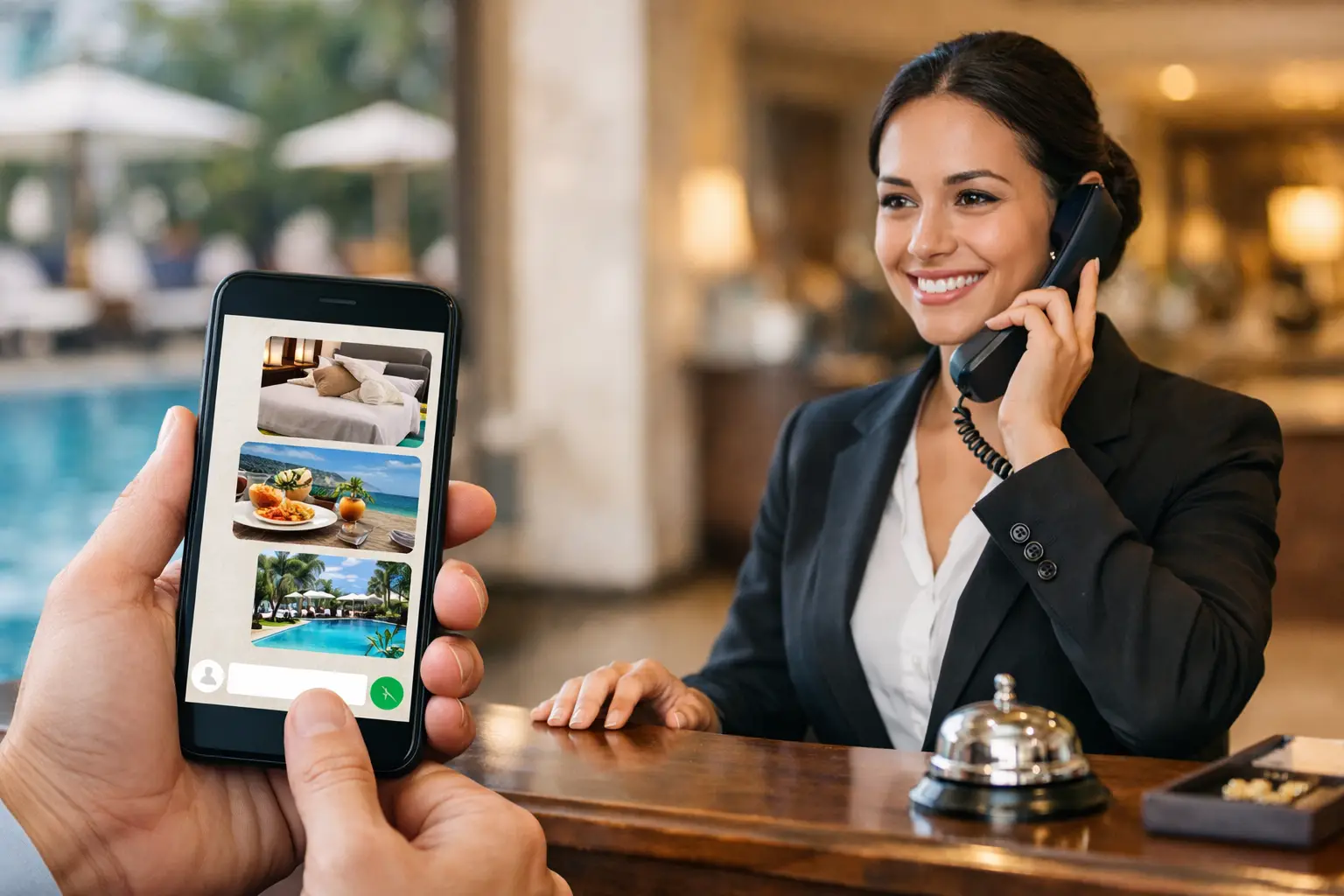
A guest lands after a delayed flight, skips the front desk line, and sends a quick message asking whether late food service is still available. If your team answers in minutes with the right options, that exchange does more than solve a service request. It shapes the guest experience, protects review scores, and creates a chance to generate incremental revenue.
That is why a WhatsApp concierge for hotels has become more than a convenience feature. For many properties, it is now a practical operating channel for guest communication before arrival, during the stay, and after checkout. The value is not just that guests prefer messaging. It is that hotels can use messaging to respond faster, personalize service at scale, and turn routine conversations into measurable business outcomes.
Why a WhatsApp concierge for hotels matters now
Hotel teams are under pressure from both sides. Guests expect immediate answers, while labor costs and staffing constraints make it harder to keep service levels high across every touchpoint. Phone calls create bottlenecks. Front desk traffic spikes at the wrong times. Email is too slow for most in-stay requests.
WhatsApp sits in a more useful middle ground. It is familiar, low-friction, and already part of daily behavior for many travelers. A guest does not need to download a new app or learn a new interface. They can simply message the property the same way they message family or a rideshare driver.
From an operations standpoint, this matters because messaging is easier to distribute across teams, easier to document, and easier to connect to automation. One staff member can handle multiple conversations at once. Common requests can be routed or pre-answered. Service history can be retained and reviewed. That gives hotel operators more control without forcing guests into a rigid process.
What guests actually use hotel WhatsApp concierge for
The strongest use case is not novelty. It is convenience tied to real moments in the guest journey.
Before arrival, guests use messaging to confirm check-in details, request airport transfers, ask about early arrival, or clarify parking. During the stay, the pattern shifts toward room service, housekeeping, restaurant reservations, local recommendations, spa bookings, maintenance issues, and late checkout requests. After departure, messaging can support lost-and-found follow-up, feedback collection, and future rebooking campaigns.
The common thread is speed. Guests are not looking for a channel because it is trendy. They are looking for the fastest path to an answer or action.
That is also where revenue enters the picture. If a guest asks about dinner, your team can present restaurant availability. If they ask about checkout time, you can offer a paid late checkout. If they mention an anniversary, you can suggest an upgraded package. Messaging creates a direct commercial moment inside a service interaction, which is often more effective than generic promotional emails.
Where hotels get the biggest business impact
The financial case for a WhatsApp concierge for hotels usually comes from four areas: reduced service friction, better staff efficiency, higher ancillary revenue, and stronger guest retention.
Reduced friction improves satisfaction. Guests who get quick answers are less likely to queue, complain, or leave negative reviews over small operational issues. Staff efficiency improves because repetitive requests can be templated, routed, or handled through automation before a human agent steps in.
Ancillary revenue is where many operators underestimate the opportunity. Messaging creates a highly contextual sales environment. Offers arrive when they are relevant, not buried in a pre-arrival email that never gets opened. A well-managed concierge flow can support upgrades, dining reservations, transportation, wellness services, event bookings, and premium add-ons with less effort from the team.
Retention improves when the hotel captures a usable communication channel tied to guest preferences and behavior. That matters even more as acquisition costs continue to rise. Hotels that build stronger first-party data and direct communication channels are in a better position to remarket without relying so heavily on third-party platforms.
Automation helps, but only if it is designed well
Many hotels hear «automated concierge» and assume the goal is to remove human interaction. That is usually the wrong approach.
Guests do not mind automation when it saves time. They do mind it when it traps them in a dead-end menu. The best hotel messaging systems use automation for speed, triage, and consistency, then make it easy to hand off to a real person when the request becomes more specific.
For example, automation can instantly answer common questions about breakfast hours, Wi-Fi access, check-out time, or parking. It can also collect intent, such as whether the guest needs housekeeping, transportation, or dining support, and send that request to the right team. But if a VIP guest has a special request or a traveler is frustrated after a travel disruption, a human response should take over quickly.
This is where system design matters more than features alone. Hotels need workflows that reflect their service model, staffing structure, and property type. A boutique hotel may prioritize high-touch personalization, while a large urban property may focus on queue reduction and departmental routing. It depends on volume, guest profile, and internal response capacity.
Integration is what turns messaging into a business asset
A standalone inbox can help, but it has limits. The larger opportunity comes when WhatsApp is connected to the rest of the hotel’s marketing and guest communication stack.
If guest Wi-Fi, CRM records, messaging history, and campaign tools work together, the hotel gets a far clearer picture of who the guest is and how to engage them. A guest who logs into property Wi-Fi, consents to communication, and uses concierge messaging is no longer just an anonymous room number. They become a known contact with preferences, visit history, and behavior data.
That creates better segmentation and better timing. Hotels can trigger pre-arrival messages, identify repeat guests, suppress irrelevant promotions, and follow up after the stay with offers that reflect actual on-site behavior. Instead of treating concierge as an isolated service channel, operators can use it as part of a broader customer acquisition and retention strategy.
This is one reason the model works especially well when combined with guest Wi-Fi marketing. The Wi-Fi network already captures high-intent, on-site traffic. Messaging extends that relationship into a direct communication channel that supports service, upsell, and post-stay remarketing.
Common mistakes hotels make with WhatsApp concierge
The first mistake is treating it like a passive inbox. If guests wait too long for replies, the channel quickly loses credibility. Hotels need clear ownership, response expectations, and escalation rules.
The second is using messaging only for support and ignoring revenue opportunities. Service and sales do not need to compete. When offers are timely and relevant, they feel helpful rather than pushy.
The third is launching without thinking through consent, data handling, and channel governance. Messaging is personal. Hotels need to respect opt-in requirements, maintain message quality, and avoid over-communication.
The fourth is buying software without an operational plan. Technology can speed up communication, but it cannot fix unclear processes. If requests are not routed correctly or departments are not aligned, the guest still feels the breakdown.
How to evaluate a WhatsApp concierge for hotels
Hotel operators should look beyond the chat interface. The better question is whether the system supports measurable performance.
Can it automate common requests without creating a bad guest experience? Can it route conversations by department or property? Can it support upsell campaigns and track conversion? Can it connect with guest Wi-Fi data, CRM workflows, or marketing automation? Can management monitor response times, volume, and service trends across locations?
Those questions matter because hotel messaging should not be judged only on adoption. It should be judged on operational savings, revenue contribution, and guest satisfaction.
For groups, there is another layer. Multi-property visibility matters. Brand standards matter. Remote configuration matters. If a solution cannot scale across portfolios while still allowing local flexibility, it may create more work than it removes.
The hotels that benefit most
Luxury properties are an obvious fit because guests expect fast, personalized service. But select-service hotels, resorts, extended-stay properties, and multi-site groups can also see strong returns.
In lower-touch environments, messaging helps maintain service quality without adding headcount. In higher-touch environments, it helps staff deliver more personalized service without losing speed. The model changes, but the commercial logic stays the same: faster communication leads to better experience, and better experience creates more revenue opportunities.
For operators already investing in guest Wi-Fi, first-party data capture, and automated marketing, WhatsApp concierge is a natural extension. It connects on-property service with digital follow-up in a way that is practical, trackable, and easier to scale than many hotel apps.
Hotels do not need more channels just to say they are modern. They need channels that reduce friction, support staff, and make each guest interaction more valuable. A well-executed WhatsApp concierge does exactly that, especially when it is connected to the data and systems you already use to grow the business.
If your property is still relying on phone queues, scattered inboxes, and disconnected guest communication, messaging is not just a service upgrade. It is a smarter operating model.
Comments are closed