
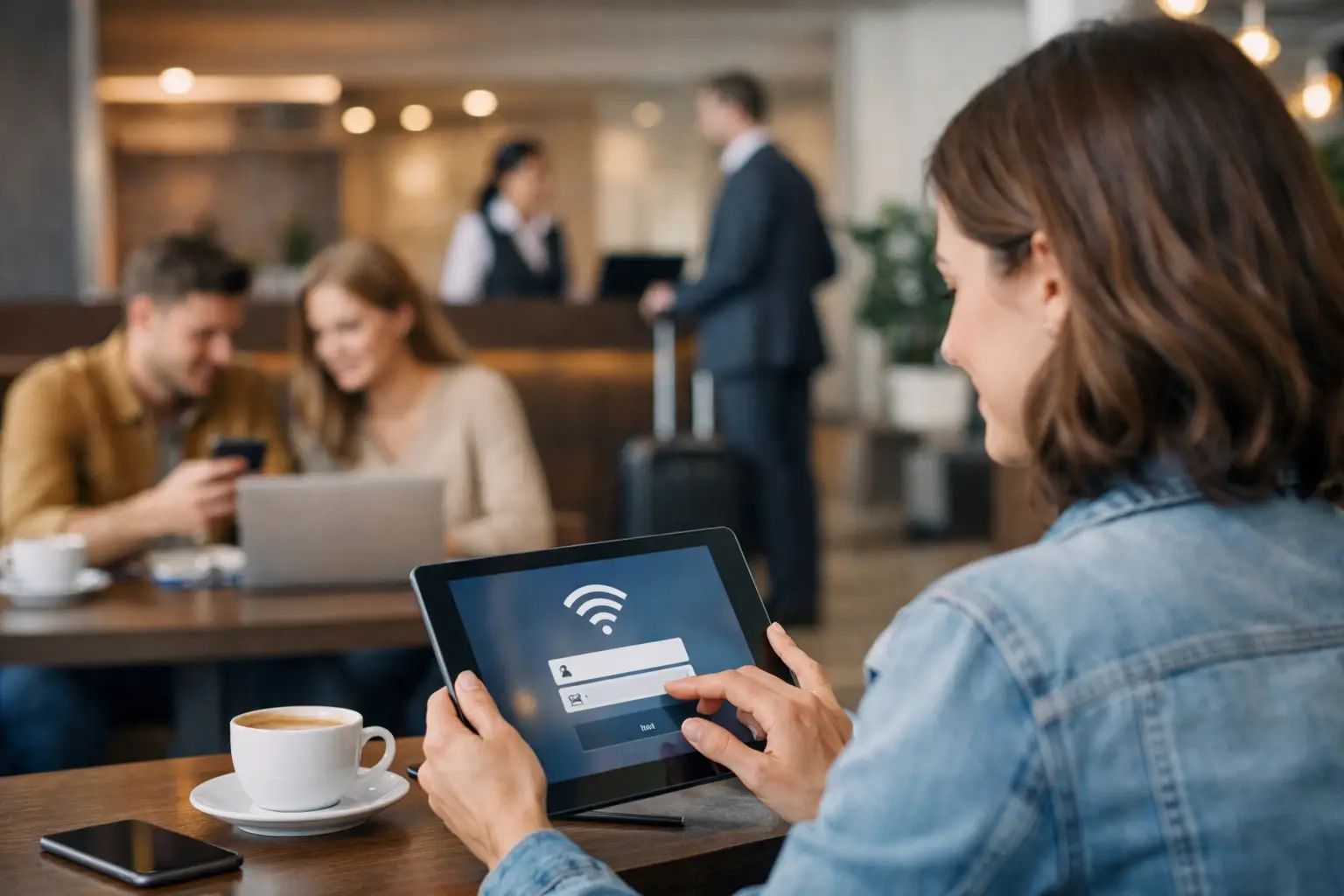
A guest asks for the Wi-Fi password, connects in seconds, and disappears from your marketing view the moment they leave. That is a missed opportunity. A captive portal changes the role of guest Wi-Fi from a basic amenity into a permission-based channel for identifying visitors, understanding behavior, and bringing customers back with relevant communication.
For hotels, restaurants, retailers, malls, clinics, transit providers, and public venues, the value is not simply providing internet access. It is connecting physical traffic to measurable marketing activity. When configured well, guest Wi-Fi can support loyalty, promotions, customer service, and remarketing without adding friction to the on-site experience.
What a Captive Portal Does for a Business
A captive portal is the branded login page customers see before they access a guest Wi-Fi network. Instead of sharing a generic password at the counter or placing an unsecured open network in front of visitors, the business can present a custom welcome screen with an access method, consent language, and a relevant next step.
A visitor may sign in with an email address, mobile number, social account, loyalty credential, or a simple form. The right approach depends on the venue and the value exchange. A quick-service restaurant may prioritize fast access and a mobile number for future offers. A hotel may connect Wi-Fi access with reservation details and guest-service messaging. A retail store may use a branded landing page to promote a seasonal collection or loyalty enrollment.
The commercial advantage is that the interaction creates a first-party data opportunity. With proper consent, businesses can associate a real visit with a contact record, campaign source, location, device behavior, and return frequency. That creates a more useful audience than a broad advertising segment built from assumptions.
The portal also gives operators control. They can define session duration, access rules, bandwidth limits, welcome-page design, and the information collected at login. For multi-location organizations, those rules can be managed centrally while each location retains locally relevant branding and campaigns.
Why Free Guest Wi-Fi Alone Produces Little Marketing Value
Many businesses already pay for internet service, access points, and network maintenance. Yet their guest Wi-Fi often does nothing beyond solving a customer convenience issue. The network may be open, use a shared password, or send every guest through the same unbranded screen. In each case, the business has limited visibility into who visited and no practical way to continue the conversation.
A well-designed captive portal closes that gap. It creates a moment of value exchange: the guest receives convenient connectivity, while the business receives consented information and an opportunity to set expectations for future contact. This does not mean asking for every possible data field. Excessive forms reduce completion rates and can make a simple Wi-Fi login feel intrusive.
The best design collects only what supports a clear commercial objective. If the goal is to promote a lunch offer next week, a mobile number with SMS consent may be appropriate. If the objective is to build an email audience for events and loyalty content, email may be the better field. The login flow should match the venue, audience, and campaign plan behind it.
From Wi-Fi Login to an Automated Customer Journey
Data capture has limited value if it remains inside a dashboard. The operational strength of Wi-Fi marketing is the ability to trigger communication after a guest has connected.
Consider a neighborhood restaurant. A new visitor logs in using an email address and agrees to receive promotions. The system can tag that contact by location, visit date, and new-guest status. A welcome email can follow shortly after the visit, perhaps offering an incentive for a return within 14 days. If the customer comes back and reconnects, the business can recognize that repeat behavior and move the contact into a different campaign rather than sending the same first-time offer again.
The same model works across industries, but the message must fit the customer journey. A hotel can send concierge information through WhatsApp, provide checkout reminders, or invite a guest to return for a future stay. A retailer can segment visitors by store location and promote a nearby event. An airport lounge or transportation provider can prioritize service updates and satisfaction feedback. A hospital or clinic may focus on clear access, privacy, and non-promotional service communication.
Automation makes these programs practical at scale. Instead of staff manually exporting contacts after each shift, the platform can route data into email, SMS, WhatsApp, CRM, or advertising audiences based on defined rules. A marketing team can build campaigns around first visit, repeat visit, lapsed visitor, location, language preference, or campaign source.
Captive Portal Data Makes Advertising More Efficient
Rising media costs make broad retargeting less attractive for many local and multi-location businesses. A Wi-Fi program can help create audiences based on confirmed physical visits rather than online browsing alone.
For example, a retail brand can build an audience of people who visited a specific store but did not return within 30 days. A restaurant group can separate guests who visit frequently from one-time visitors. A hotel can exclude recent guests from acquisition ads and instead show them a direct-booking offer or a loyalty message. When first-party contact and visit data are structured correctly, campaign budgets can be directed toward higher-intent audiences.
This does not eliminate the need for paid media. It makes paid media more accountable to real-world foot traffic. Integrations with tools such as Facebook and Google Pixel can support remarketing and conversion measurement, while email and messaging automation provide owned channels that do not require a new ad spend for every touchpoint.
The trade-off is that data quality matters. If the portal is difficult to use, guests will abandon it. If campaign tags are inconsistent across locations, reporting becomes unreliable. If consent is not captured clearly, the business risks damaging trust and limiting how the data can be used. Technology should support a disciplined marketing process, not become another disconnected database.
Design the Login Experience Around the Venue
The most effective portal is not necessarily the one that collects the most information. It is the one that balances access speed, brand presentation, customer consent, and the next action the business wants to encourage.
For high-turnover venues, such as coffee shops and fast-casual restaurants, keep the screen concise. Show the brand, explain the access option, and avoid asking for details that are not immediately useful. For longer-stay environments, including hotels, waiting rooms, coworking spaces, and malls, there may be more room to introduce loyalty benefits, concierge support, or localized offers.
Brand consistency matters as well. The portal should look like an extension of the business, not a technical interruption supplied by a router. Use the same visual language, promotional standards, and privacy approach customers see elsewhere. If the network is deployed across multiple brands or franchise locations, centralized templates can protect brand standards while allowing local operators to promote their own events and offers.
Deployment Should Not Become an IT Project That Stalls Marketing
A portal program involves network configuration, access point compatibility, cloud management, security settings, and campaign setup. That complexity is real, but it should not force a marketing team to become a networking department.
The most practical implementation model combines technical onboarding with marketing planning. Before launch, define the guest access flow, required consent language, data fields, segmentation rules, and first automated campaigns. Then configure compatible hardware remotely where possible, test the guest experience on common devices, and establish a reporting baseline.
For enterprise groups and channel partners, remote configuration and multi-brand hardware compatibility are especially valuable. A technology integrator can add a measurable marketing layer to an existing Wi-Fi deployment. An agency can offer location-based data capture and automated follow-up without building network expertise from scratch. Wifi Marketing supports this model by pairing cloud-based Wi-Fi marketing technology with configuration, installation guidance, and dashboard training.
Measure Business Outcomes, Not Just Connections
Connection counts are useful, but they do not prove marketing impact. A stronger reporting framework tracks how guest Wi-Fi contributes to customer acquisition, retention, and revenue.
Start with portal completion rate. If many people see the login page but few connect, the form, loading speed, or access method may need attention. Next, review the percentage of contacts who provide marketing consent, the growth of your usable first-party audience, and the performance of follow-up campaigns.
Then connect those signals to commercial behavior. Look for repeat visits after a welcome offer, redemption rates by location, revenue from loyalty segments, email engagement, message response rates, and the cost to reactivate lapsed guests. A captive portal should be treated like any other performance channel: test it, segment it, and improve it based on evidence.
The strongest programs begin with one clear use case rather than an oversized data strategy. Give guests a good reason to connect, make their next interaction useful, and let every visit improve the relevance of the next message.
Comments are closed